Introduction
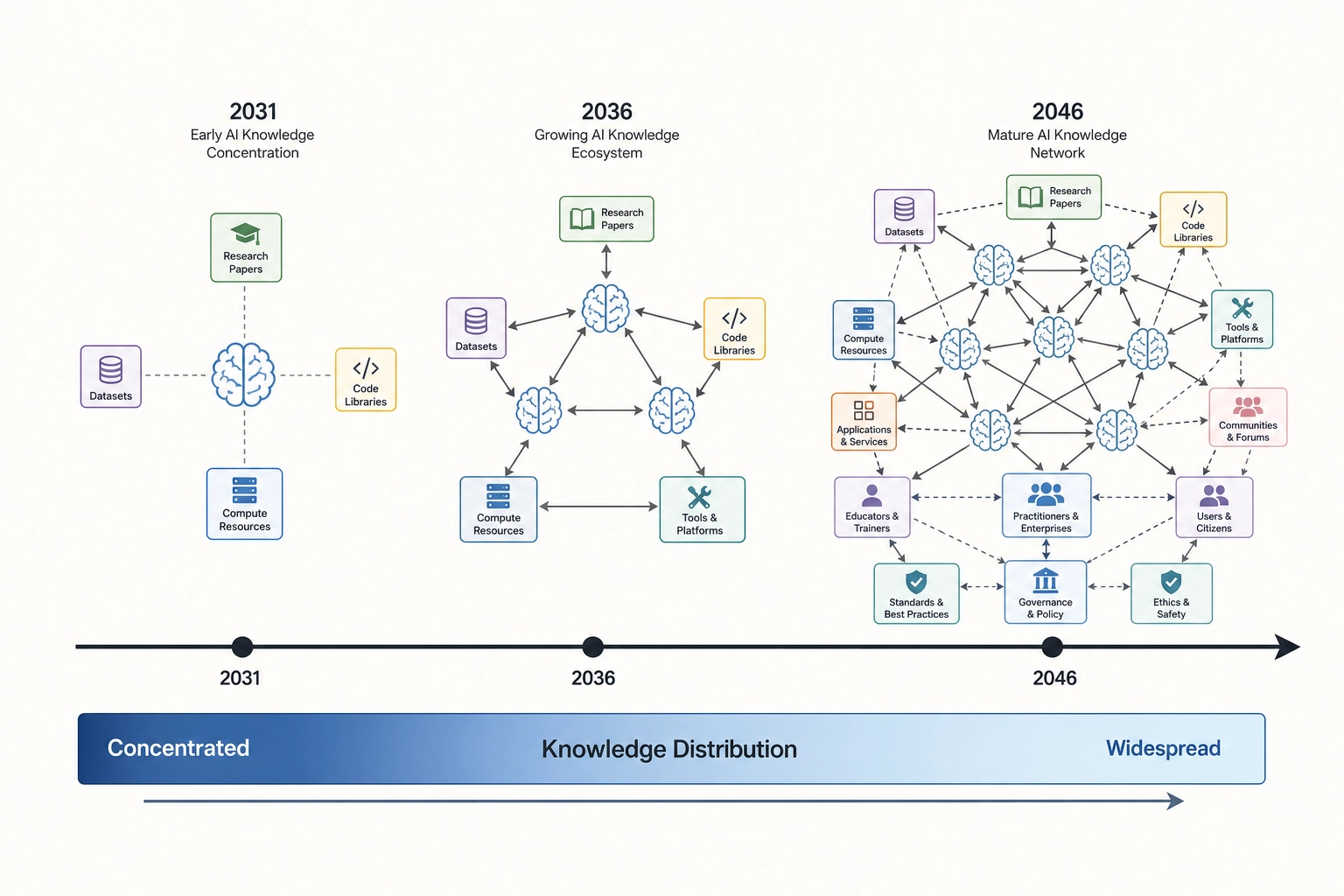
Brain encoding models are publicly available. The neuroscience literature is open. The engineering components - computer vision, audio analysis, LLMs, VLMs - are commoditizing rapidly. As of April 2026, no published or commercially available system integrates these layers into a content-performance prediction pipeline. But the components are sitting on a shelf, and the shelf is public. The question is not whether this knowledge will exist. The question is when it becomes widespread, who has it first, and what the lag between early adopters and everyone else looks like.
Chapter 12 asked what Khozai could be used for - specific applications, good and bad, grounded in the framework’s concrete capabilities. This chapter asks a different question: what happens to the world when the understanding Khozai represents is no longer rare? Chapter 12 is about a tool. This chapter is about a shift in knowledge distribution.
What this chapter covers: Three time horizons (five, ten, and twenty years), seven levels of social organization (individuals, families, organizations, countries, religion, culture, humanity), the structural dynamics of who develops this understanding first, and what changes if understanding becomes widespread.
What this chapter does not cover: Specific technical implementation paths, regulatory proposals, or business strategies. Those would require prediction; this chapter offers structured speculation.
Speculation boundary. Everything in this chapter is structured speculation, not prediction. Where the author has more confidence, the language says “likely.” Where the author is guessing, the language says “might” or “could.” The reader should hold all of it loosely.
1. Three Time Horizons
The projections are organized around three horizons: five years (approximately 2031), ten years (approximately 2036), and twenty years (approximately 2046). These are rough markers that anchor the projections to a timeline. The actual pace of change could be faster or slower.
1.1 Five-Year Horizon (Approximately 2031)
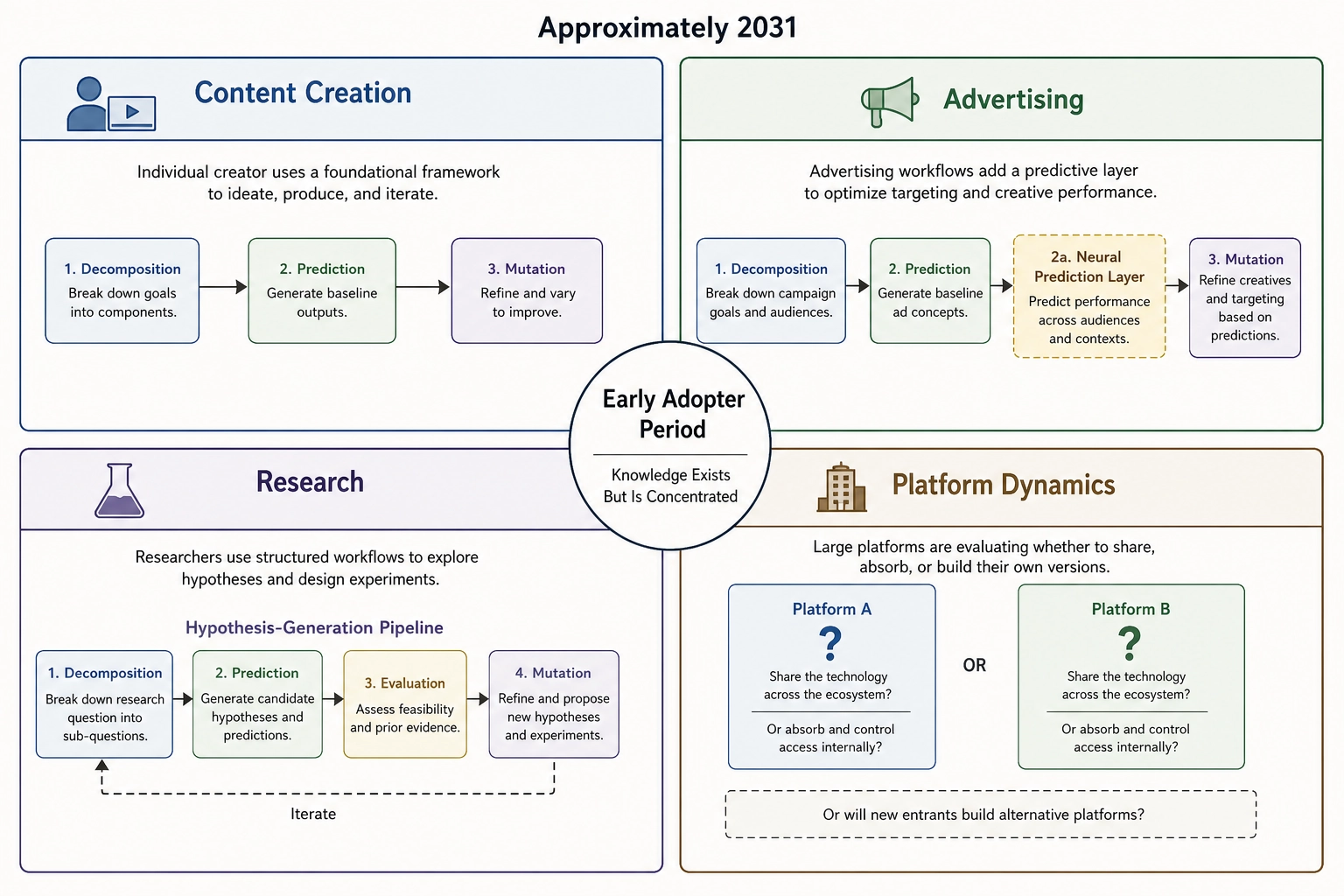
What might exist by then. Brain encoding models could improve substantially - TRIBE v2 already exhibits log-linear scaling without plateau (Evidence: Moderate - reported by Meta FAIR in model documentation, not independently benchmarked for content-performance prediction), and a v3 or v4 might achieve finer temporal resolution, better subcortical reconstruction quality, or individual-specific prediction. The creative intelligence market (50+ companies as of April 2026) could begin incorporating neural prediction layers, moving beyond semantic tagging into physics-level or neuroscience-grounded analysis. A handful of independent operators - researchers, sophisticated content creators, small studios - might build pipelines similar to Khozai’s, using publicly available tools. Platform algorithms could continue their shift from audience-first to creative-first matching, making content-property understanding even more operationally relevant.
What probably would not exist yet. Widespread public literacy about how content properties map to neural activation. Regulatory frameworks specific to neuroscience-informed content optimization. Consumer-facing tools that make this knowledge accessible to non-technical users. The five-year horizon is likely still an early-adopter period - the knowledge exists but is concentrated among a small number of technically sophisticated actors.
| Domain | Possible Good Outcome (Speculation) | Possible Bad Outcome (Speculation) |
|---|---|---|
| Content creation | Creators who understand the framework could produce more effective educational, public health, and artistic content by design rather than by trial and error | Early adopters with resources could gain a structural advantage in attention capture, widening the gap between sophisticated and unsophisticated content producers |
| Advertising | Advertisers could reduce waste by understanding which physical properties of their creative actually drive outcomes, leading to fewer but more effective ads | The same understanding could be used to design ads that are more difficult for viewers to resist, shifting the balance of power further toward advertisers |
| Research | Neuroscience and communication research could gain a new empirical tool - testing hypotheses about content effectiveness without requiring fMRI scanners | Research could be captured by commercial interests, with the most sophisticated applications remaining proprietary while the academic versions lag |
| Platform dynamics | Platforms might face pressure to share more of their internal content-analysis with creators, reducing the information asymmetry described in Chapter 1 section 1.2 | Platforms might instead absorb the technology, using it to further optimize their own recommendation algorithms without sharing the understanding with users |
1.2 Ten-Year Horizon (Approximately 2036)
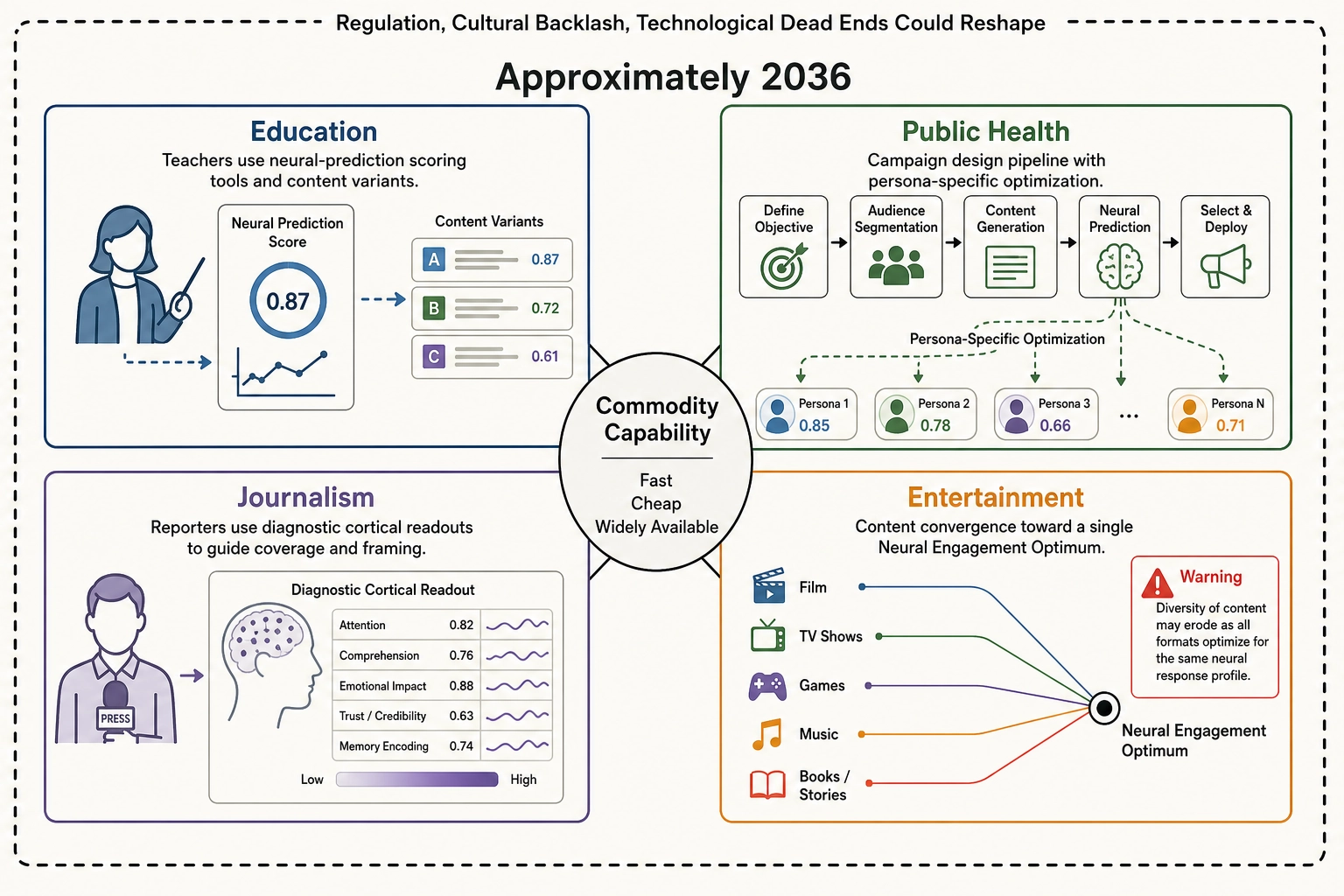
What might exist by then. If brain encoding models continue their current trajectory, cortical activation prediction from content could become a commodity capability - fast, cheap, and widely available. The creative intelligence industry might have consolidated around a smaller number of platforms that integrate physics-level decomposition, neural prediction, and behavioral correlation. Controlled single-variable content mutation - what Chapter 7 describes - could be standard practice in professional content production. Consumer-facing tools might begin to emerge: apps or plugins that score content along neural-activation dimensions before publication.
A decade allows for regulatory intervention, cultural backlash, technological dead ends, and unexpected developments that reshape the landscape in ways that cannot be anticipated from 2026.
| Domain | Possible Good Outcome (Speculation) | Possible Bad Outcome (Speculation) |
|---|---|---|
| Education | Teachers and curriculum designers could use neural-prediction tools to design learning materials that are empirically calibrated for attention and retention, adapting content properties to different age groups and learning contexts | The same tools could be used to design content that holds attention without teaching - engagement optimized at the expense of comprehension, producing content that feels compelling but leaves the viewer knowing nothing more than before |
| Public health | Health communication campaigns could be empirically designed to maximize behavioral change - tested not just for message clarity but for predicted neural engagement with the specific populations they target | Manipulative health messaging could become more effective - anti-vaccination campaigns, miracle-cure marketing, and other harmful health content could be engineered with the same neuroscience-informed precision |
| Journalism | Reporters and editors could use the framework to understand which presentation choices help audiences engage with complex stories versus which choices merely trigger emotional reactions that crowd out comprehension | The distinction between informing and manipulating could become harder to maintain, as the same tools that help a journalist design an engaging investigation could help a propagandist design an engaging lie |
| Entertainment | Creators could develop a deeper understanding of their craft - not replacing intuition but grounding it in measurable properties, allowing systematic exploration of creative choices | Content could converge toward a neural-engagement optimum - a narrowing of creative diversity as producers chase the same activation patterns, producing content that is technically effective but culturally monotonous |
1.3 Twenty-Year Horizon (Approximately 2046)
Projecting the state of neuroscience, AI, and media technology two decades forward is an exercise in humility more than in foresight.
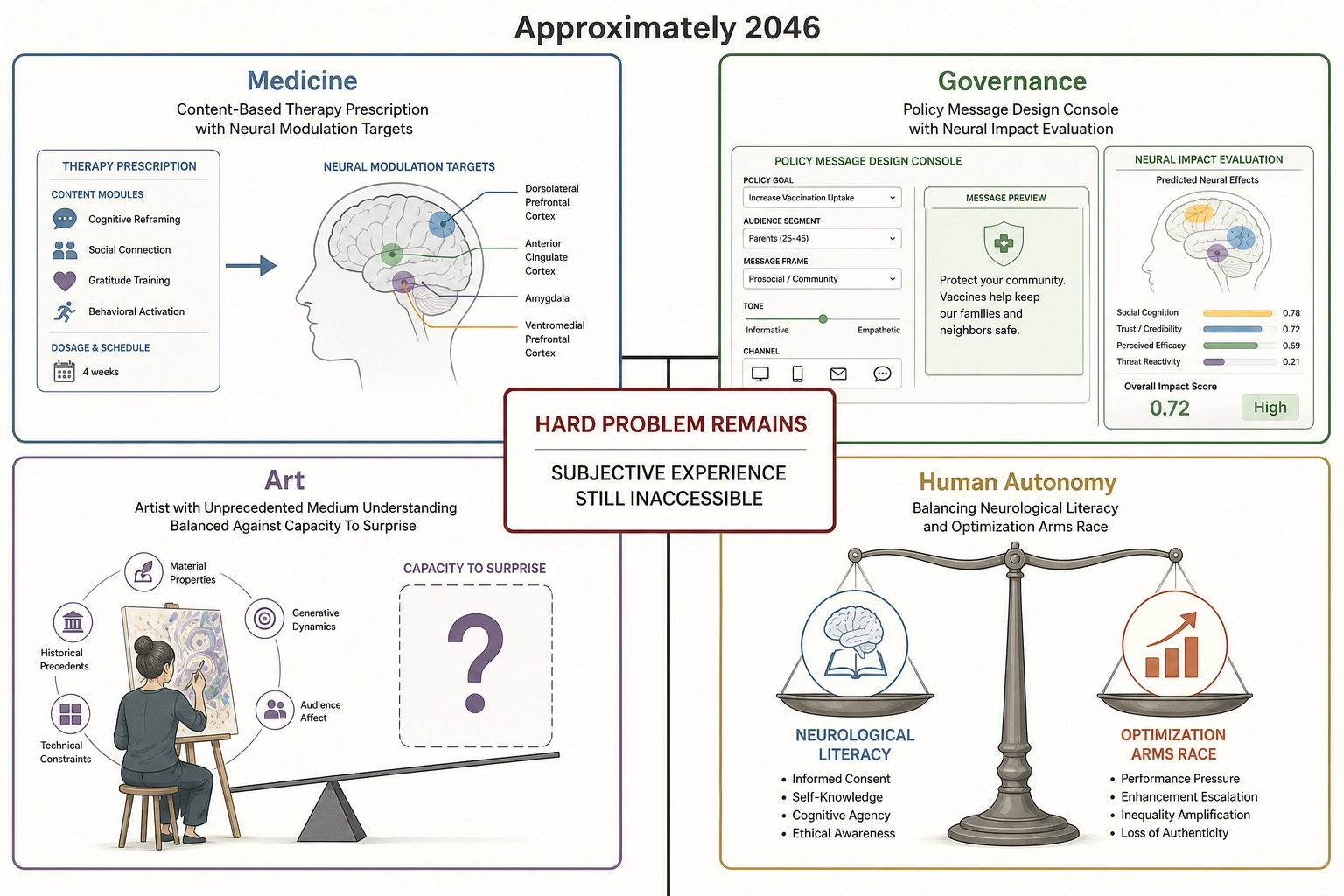
What might exist by then. Individual-specific brain encoding models that predict not just average neural activation but person-specific responses. Real-time content adaptation - video, audio, and narrative structure modified on the fly based on predicted neural engagement for the specific viewer. Full-brain prediction, including subcortical structures, at temporal resolutions approaching the brain’s own processing speed. Integration of content-neural prediction with biometric feedback loops - content that monitors the viewer’s physiological state and adapts accordingly.
What might not exist. Access to subjective experience. Chapter 11 section 1.1 established that the hard problem of consciousness is a boundary condition on any framework that works from outside the viewer’s experience. Twenty years of improved measurement might narrow the gap between predicted neural activation and actual neural activation to near zero - and the subjective quality of the viewer’s experience would remain as inaccessible as it is today. Better models measure the pattern more accurately. They do not access what the pattern feels like from inside.
| Domain | Possible Good Outcome (Speculation) | Possible Bad Outcome (Speculation) |
|---|---|---|
| Medicine | Content-based therapeutic interventions could become a recognized clinical tool - video sequences empirically designed to modulate specific neural activation patterns for anxiety, PTSD, or depression, prescribed and monitored like medication | The same capability could be weaponized as a coercion tool - content designed to induce specific emotional states in unwilling or unaware viewers, whether for interrogation, behavioral conditioning, or political control |
| Governance | Policymakers could use the framework to evaluate the neural impact of public communication, designing policy messages that are genuinely understood rather than merely broadcast | Authoritarian governments could use the same tools to design propaganda that is neurologically optimized for compliance - content that activates social-conformity circuits while suppressing critical evaluation |
| Art | Artists could gain unprecedented understanding of their medium - knowing not just what they intend but what the viewer’s brain is likely to do with their choices, creating a new form of intentional craft | Art could lose its capacity to surprise, as audiences become aware that their responses are being predicted and engineered, creating a cynicism that poisons the relationship between creator and viewer |
| Human autonomy | Widespread understanding of how content affects the brain could empower individuals to make more informed choices about what they consume - a form of neurological literacy | The same understanding, concentrated in the hands of content producers rather than consumers, could reduce autonomy - creating an arms race between optimization and resistance where the optimizer always has more data |
2. Impact by Level
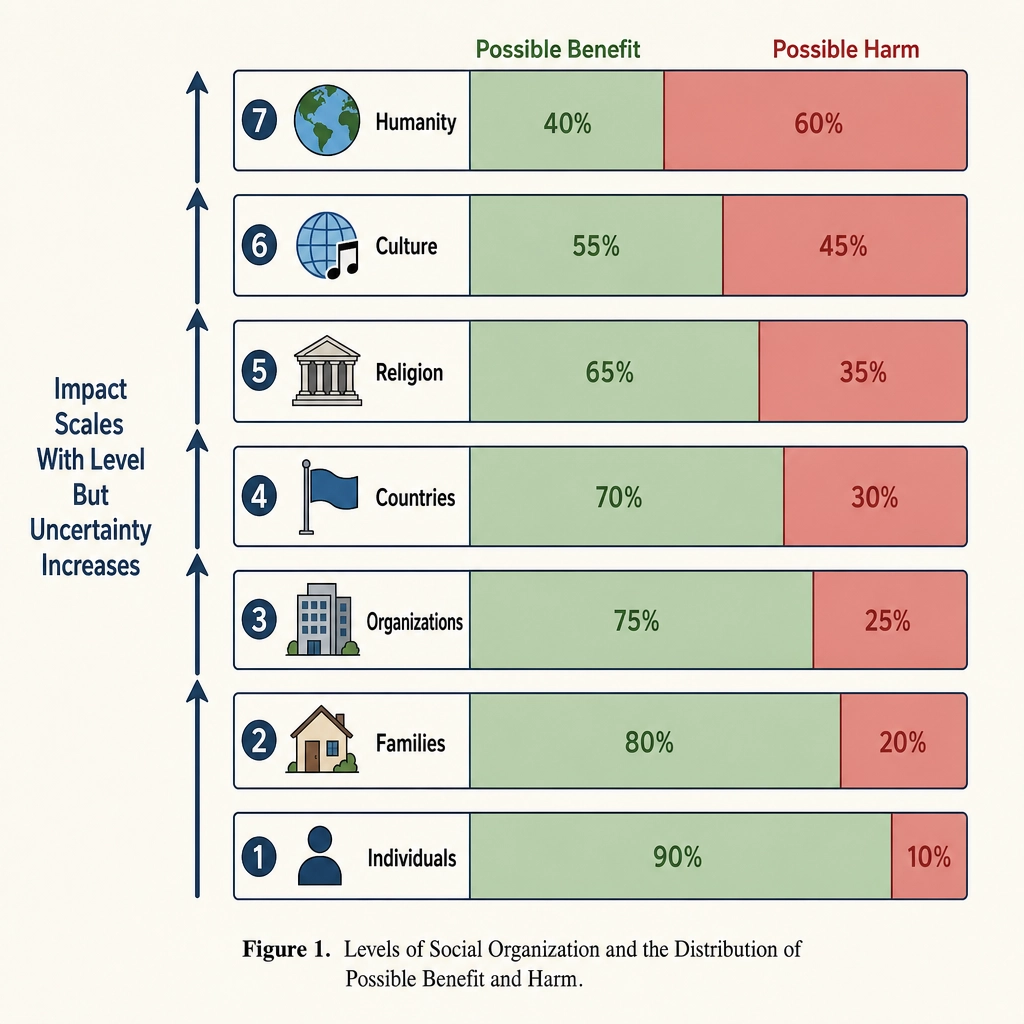
The three time horizons describe when. This section describes where - the levels of social organization that might be affected.
2.1 Individuals
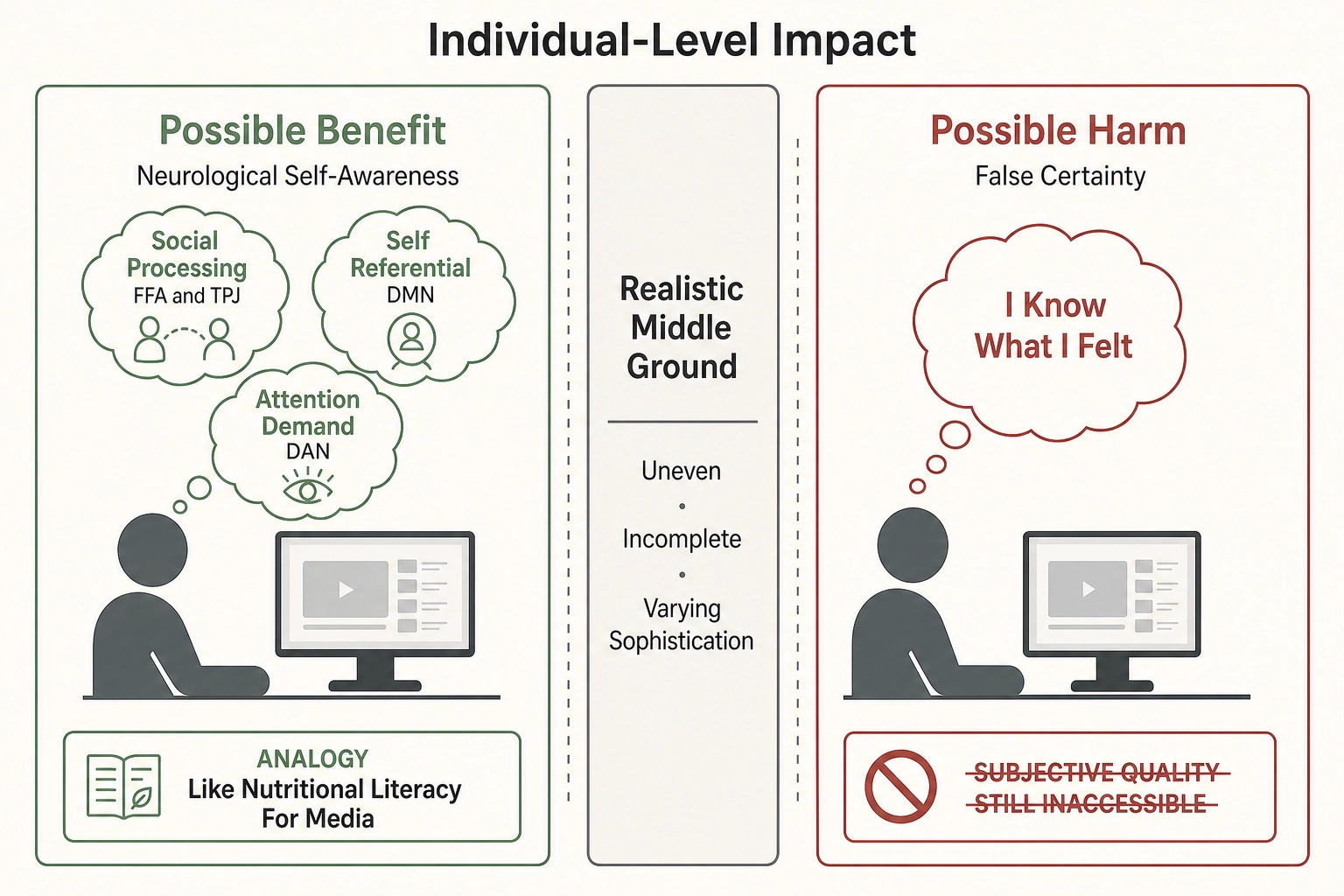
Possible benefit. An individual who understands how content properties map to neural activation gains a form of self-knowledge. They could learn to recognize when a piece of content is activating their social-processing circuits (predicted strong fusiform face area and temporal parietal junction activation) versus their self-referential circuits (predicted default mode network activation) versus their attention-demand circuits (predicted dorsal attention network activation). This is not mind-reading - it is pattern recognition applied to one’s own consumption. It might function like nutritional literacy: knowing what you are consuming does not prevent you from consuming it, but it changes the relationship from passive to informed.
Possible harm. The same individual, if they lack the framework’s epistemic discipline, could develop a false sense of understanding - believing they know why they feel what they feel because they can name which cortical regions are predicted to activate. The framework explicitly states that it cannot access subjective quality (Chapter 11 section 1.1). A person who mistakes “strong fusiform face area activation predicted” for “I know what I felt about that face” has misunderstood the tool. Partial knowledge, poorly held, could be worse than no knowledge - it creates confident ignorance.
The realistic middle ground. Most individuals, if this knowledge becomes widespread, would likely engage with it the way they engage with nutritional information or financial literacy: unevenly, incompletely, and with varying degrees of sophistication. Some would use it well. Some would misuse it. Most would absorb a simplified version that captures the general principle - “content is designed to activate specific brain responses” - without mastering the technical details.
2.2 Families
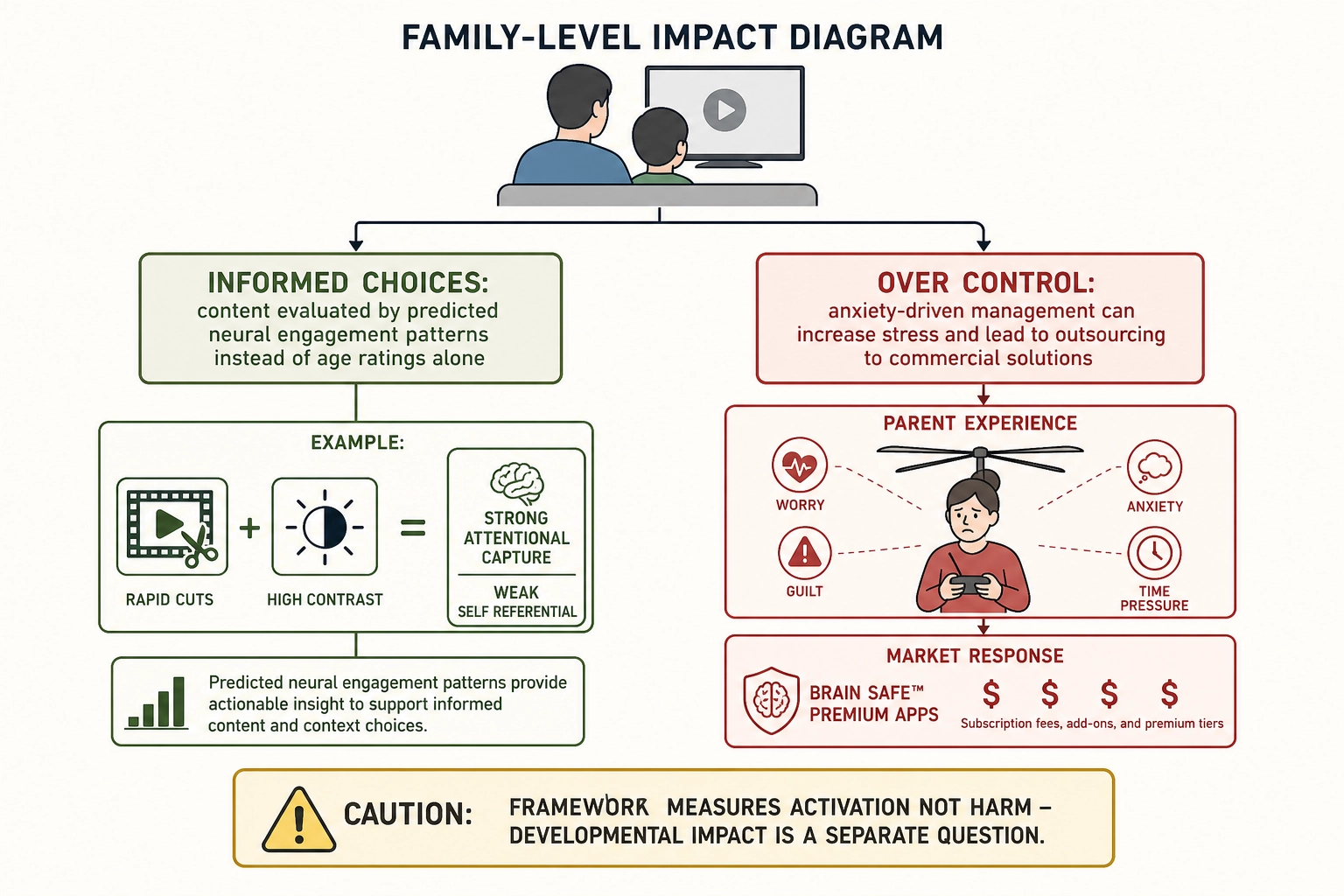
Possible benefit. Parents who understand how content properties map to neural activation could make more informed choices about what their children watch. Instead of relying on age ratings or content warnings - which describe narrative content, not stimulus properties - they could evaluate content based on predicted neural-engagement patterns. A video that is rated “safe” by content standards but designed with rapid cuts, high-contrast color transitions, and audio patterns that drive predicted attentional-capture circuits might receive more scrutiny. Families could develop a shared language for discussing why certain content feels compelling, moving from “I don’t like that show” to “that show uses physical stimulus properties that predict strong attentional capture and weak self-referential processing - it grabs your attention without giving you anything to think about.”
Possible harm. The same knowledge could fuel anxiety and over-control. Parents who learn that specific content properties predict specific neural activation patterns could become hypervigilant about every stimulus their children encounter, creating a restrictive media environment driven by fear rather than understanding. The framework does not predict harm - it predicts neural activation. Strong fusiform face area activation is not inherently good or bad. A parent who treats every predicted neural-engagement pattern as a threat has confused measurement with judgment.
A further concern. If neuroscience-informed content analysis tools become consumer-facing, they could create a market for “neural safety” products - apps that score children’s content on neural-engagement dimensions and sell premium “brain-safe” content subscriptions. This market could exploit parental anxiety regardless of whether the scores predict anything meaningful about child development. The tools would be measuring real properties (predicted cortical activation from content), but the interpretation - that certain activation patterns are harmful for children - would be speculation layered on top of measurement. The framework has nothing to say about what patterns are healthy or harmful. It measures which aspects of perception and emotion are engaged, how strongly, and how independently. Whether that engagement is good for a developing brain is a question for developmental neuroscience, not for a content-analysis tool.
2.3 Organizations
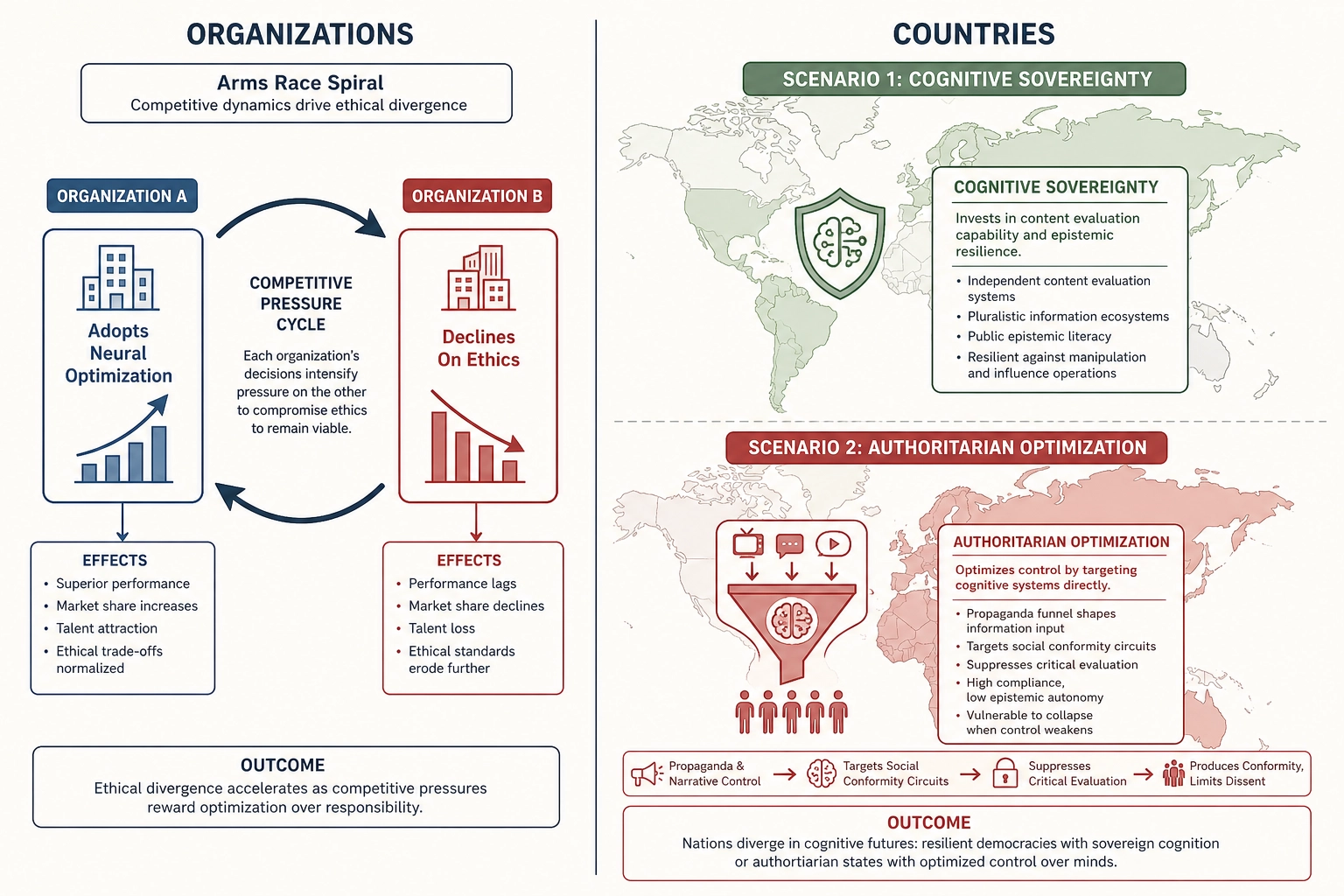
As Chapter 12 detailed, organizations that produce content could shift from intuition-driven to evidence-driven content development - with both constructive applications (education, public health, journalism) and destructive ones (addiction engineering, manipulation). The speculative question here is not what organizations could do with the framework (Chapter 12 covered that), but what happens when the capability is no longer rare.
The organizational arms race. If neuroscience-informed content analysis becomes a competitive advantage, organizations that do not adopt it could fall behind. This creates an adoption pressure that operates independently of ethical considerations. A media company that declines to use neural-prediction tools on ethical grounds competes against one that uses them aggressively. Whether the ethical company survives depends on whether audiences value the restraint - and whether they can even detect it. The concern is not the tool itself but the competitive dynamics that make adoption feel mandatory regardless of intent.
2.4 Countries
Possible benefit. Countries that develop domestic expertise in neuroscience-informed content analysis could gain a form of cognitive sovereignty - the ability to understand and evaluate the content their populations consume, whether that content originates domestically or abroad. A country whose media regulators understand how content properties map to predicted neural activation could evaluate foreign content not just for narrative content (does it contain propaganda?) but for stimulus design (does it use physical properties optimized for attentional capture and emotional activation in ways that differ systematically from domestic content?). This is speculative, but the principle is straightforward: understanding the mechanism gives you the ability to evaluate the stimulus.
Possible harm. The same capability, in the hands of an authoritarian government, could become a tool for designing state propaganda that is neurologically optimized for its domestic audience. A government that understands which content properties predict strong social-conformity activation (predicted activation in regions associated with social processing and norm compliance) and which predict critical-evaluation activation (predicted frontoparietal control network (the brain regions involved in deliberate, analytical thinking and evaluating whether incoming information makes sense) engagement) could, in principle, design content that maximizes the former while minimizing the latter. Whether this would work in practice is unknown - the framework’s predictions are probabilistic and population-average, and individual variation is large. But the intent and the direction of optimization are concerning.
The geopolitical dimension. If neuroscience-informed content optimization becomes a state capability, it could create a new axis of asymmetric advantage. Countries with strong neuroscience research infrastructure, large AI research teams, and sophisticated media production capabilities could develop this capacity faster than countries without those resources. This is not fundamentally different from other technological asymmetries - nuclear technology, cyber capability, AI research - but it operates in the domain of attention and persuasion, where the effects are harder to detect and attribute.
2.5 Religion
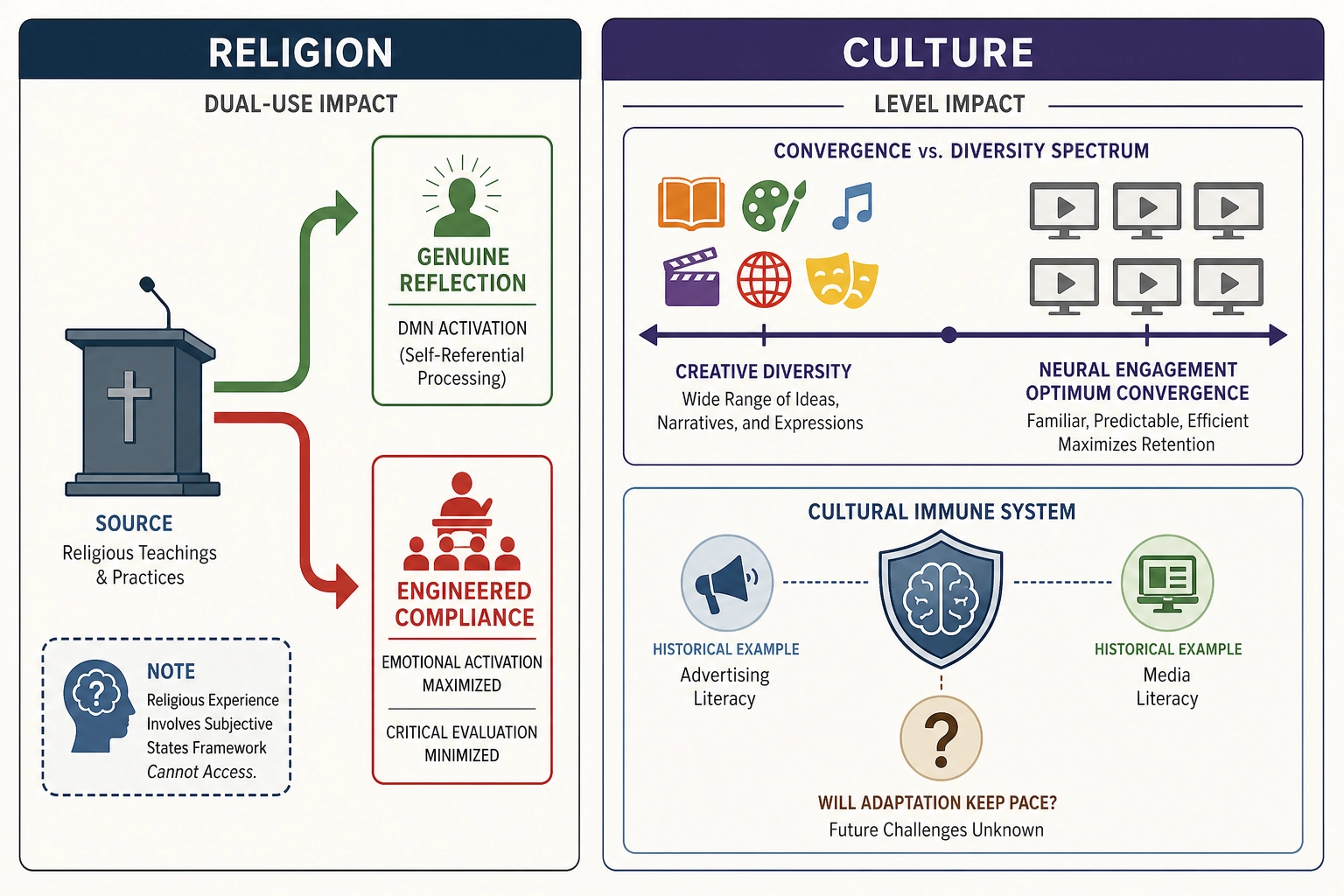
The good and bad applications of the framework to religious communication follow the same dual-use logic Chapter 12 described for other domains: a preacher could design sermons that foster genuine reflection (stronger predicted default mode network activation), or a manipulative leader could engineer compliance by maximizing emotional-processing activation while minimizing critical-evaluation activation. The history of religious communication already includes sophisticated persuasion techniques - oratory, music, architecture, ritual. Neuroscience-informed optimization would intensify existing dynamics rather than create new ones, but the intensification itself is a concern.
The deeper question. Religious experience involves subjective states that the framework explicitly cannot access (Chapter 11 section 1.1). The framework can predict which cortical regions might activate during religious content. It cannot predict whether the viewer experiences transcendence, conviction, or peace - the things religious practitioners would consider the point. This limitation should temper any claims about what neuroscience-informed religious content could achieve.
2.6 Culture
As Chapter 12 detailed for art specifically, neuroscience-informed content analysis could enrich cultural criticism by adding a neural-prediction layer to existing aesthetic frameworks, or it could narrow cultural diversity if creators across genres converge on similar neural-engagement optima. The speculative question at the cultural level is whether the convergence pressure or the enrichment wins over time.
The cultural immune system. Cultures develop antibodies to manipulation techniques over time. Audiences learned to recognize and discount advertising rhetoric, political spin, clickbait headlines, and algorithmic content recommendations. If neuroscience-informed content optimization becomes widespread, audiences might develop analogous defenses - a cultural literacy about how content is designed to affect them. Whether this adaptation keeps pace with the optimization is an open question. Historical precedent is mixed: advertising literacy is widespread but advertising still works; media literacy is taught in schools but misinformation still spreads.
2.7 Humanity
The author offers these observations with minimal confidence.
Possible benefit. If the understanding that Khozai represents - how physical stimulus properties map to neural activation, how neural activation maps to behavioral response, how controlled manipulation of stimulus properties produces measurable changes in behavior - becomes widely shared human knowledge, it could represent a genuine advance in self-understanding. Humanity would know, in a precise and empirical way, how the content it creates affects the brains it has. This knowledge could inform better decisions at every level: personal media consumption, family media policy, organizational content strategy, national communication policy, and global information governance. The knowledge is, in principle, neutral - it describes mechanisms, not prescriptions. How it is used depends on who has it and what they intend.
Possible harm. The same knowledge, if unevenly distributed, could create a permanent information asymmetry between those who understand how content affects the brain and those who do not. This asymmetry already exists - the platforms described in Chapter 1 section 1.2 already analyze content at a level they do not share with creators or consumers. But the current asymmetry is technological: platforms have better algorithms. The future asymmetry could be epistemological: some actors would understand the neuroscience of persuasion while others would not. This is a deeper kind of advantage, because it operates at the level of understanding rather than tooling, and it is harder to close with regulation or technology transfer.
The fundamental tension. The knowledge Khozai describes is coming regardless of what Khozai does. Brain encoding models are publicly available. The neuroscience literature is open. The engineering tools are commoditizing. If Khozai did not exist, someone else would build something similar - perhaps less formally, perhaps less honestly, perhaps without the epistemic discipline that the book writing rules enforce. The question is not whether this knowledge will exist but who understands it first and how the gap between early and late adopters plays out.
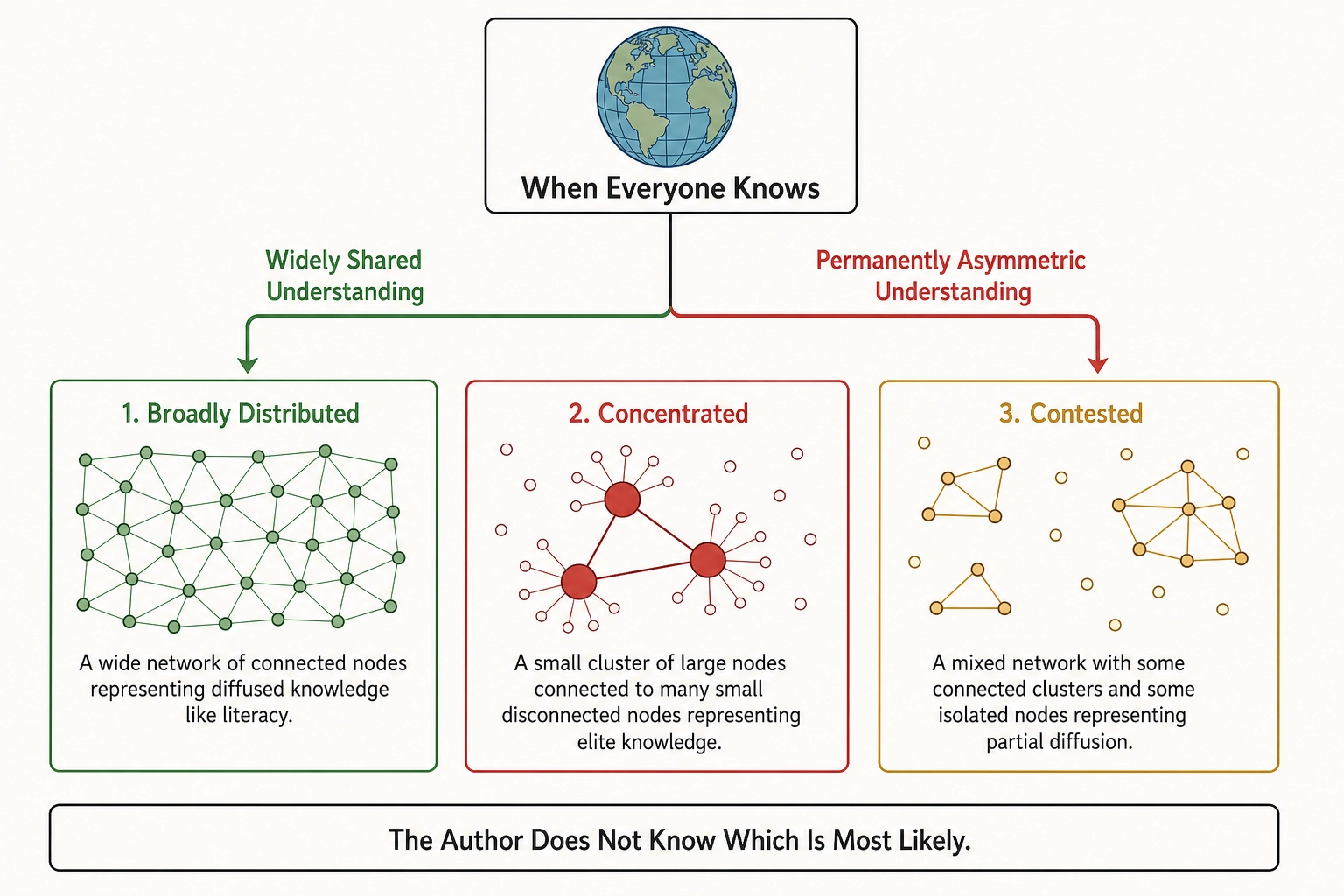
There are three possible outcomes, and the author does not know which is most likely:
-
Broadly distributed understanding. The knowledge diffuses widely, like literacy or numeracy. Most people develop a basic understanding of how content affects the brain. This creates an informed public that is harder to manipulate, reduces the information asymmetry between creators and consumers, and enables better individual and collective decisions about media consumption. This is the optimistic scenario, and it requires deliberate effort - educational curricula, public communication, accessible tools, and cultural adaptation.
-
Concentrated understanding. The knowledge remains in the hands of a small number of sophisticated actors - technology companies, state actors, and specialized agencies. These actors use the knowledge to optimize content for their own objectives, while the broader public remains as naive as it is today. This is the pessimistic scenario, and it is the default - specialized knowledge tends to concentrate unless deliberate mechanisms distribute it.
-
Contested understanding. The knowledge diffuses partially, creating a landscape where some actors are sophisticated and others are developing sophistication, where regulation lags behind capability, where cultural adaptation is uneven, and where the ongoing contest between optimization and resistance produces a dynamic equilibrium that shifts over time. This is probably the most realistic scenario, and it is the least satisfying - it offers no clean resolution, only an ongoing process.
3. The Knowledge Is Coming Regardless
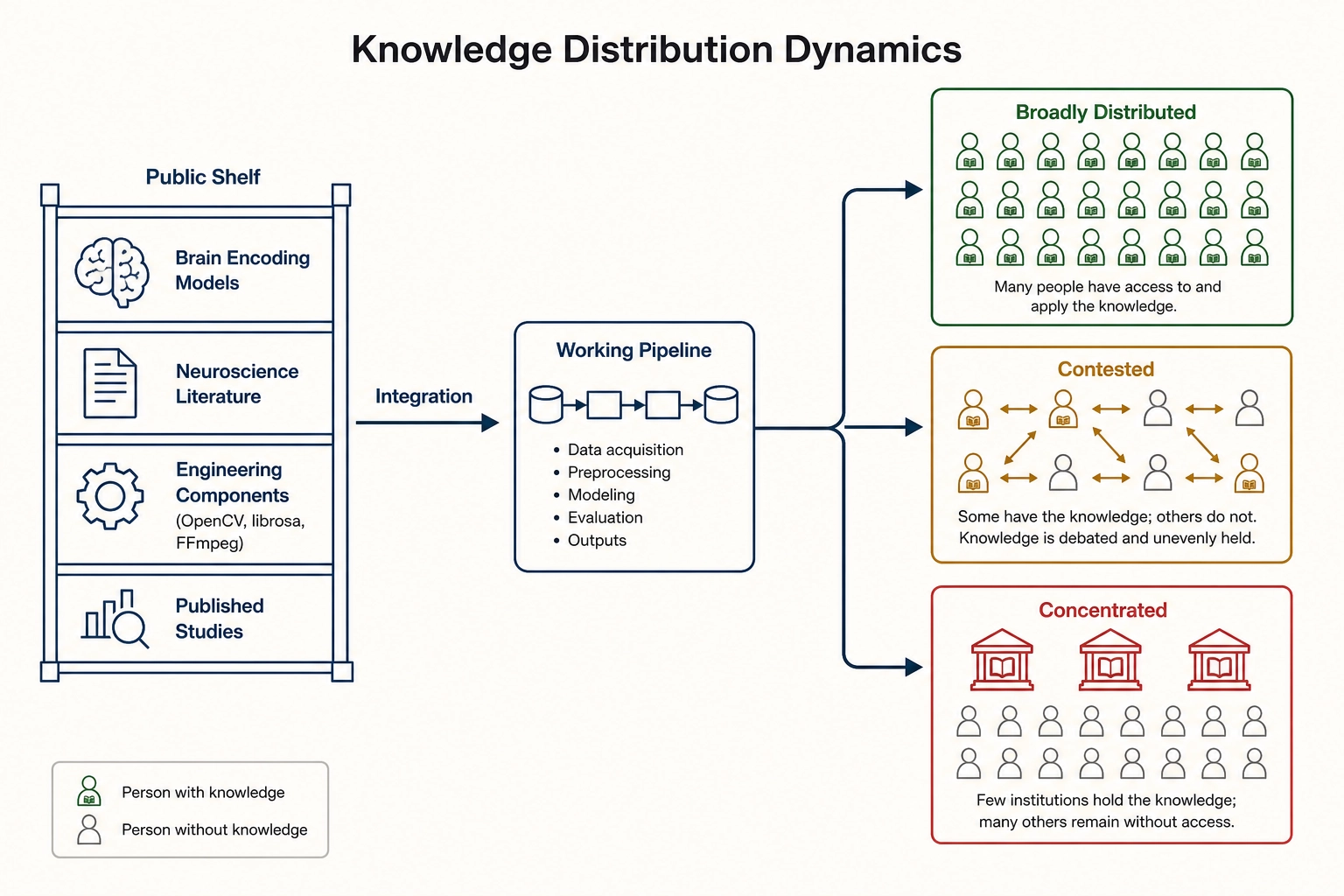
This section grounds the speculation in a structural claim: the understanding Khozai describes is not contingent on Khozai.
Brain encoding models are public. TRIBE v2’s model, code, and weights are publicly available under CC BY-NC 4.0. Anyone intending commercial use faces the same three options described throughout this book: (1) obtain a commercial license from Meta, (2) rebuild on open datasets like CNeuroMod, or (3) use TRIBE v2 only for non-commercial research phases. The Algonauts Challenge has produced a global research community competing to improve brain-activation prediction from naturalistic stimuli. As of April 2026, more than 260 teams participated in the Algonauts 2025 Challenge alone. Evidence: Strong - publicly verifiable participation records from the Algonauts Project. This is not a niche capability - it is an active, competitive, international research field with publicly shared advances.
The neuroscience is established. The brain-to-performance studies cited throughout this book - Venkatraman et al. (2015), Falk, Berkman & Lieberman (2012), Tong et al. (2020), Scholz, Chan, Falk et al. (2025) - are published in peer-reviewed journals and available to anyone. Evidence: Strong - peer-reviewed, replicated across multiple independent research groups and content domains. The finding that brain activation predicts content performance better than self-report is part of the scientific record.
Counter-evidence and limitation. The brain-to-performance studies used real fMRI scans of subjects watching content in controlled laboratory conditions. Whether these findings transfer to predicted cortical activation from encoding models (rather than measured activation) and to naturalistic viewing conditions (rather than laboratory settings) is the gap Bet 2 exists to test. The psychologist Tal Yarkoni (2022) has argued that the generalizability crisis in psychology means that lab-to-field transfer should be assumed to fail until demonstrated, not assumed to succeed. Evidence: Strong - peer-reviewed methodological critique with broad support in the field.
The engineering components are commoditizing. Computer vision (OpenCV), audio analysis (librosa), video processing (FFmpeg), optical flow (RAFT), shot detection (TransNetV2), large language models, and vision-language models are all open-source, production-ready, and improving rapidly. Evidence: Strong - publicly available repositories, active development, millions of downloads. The physics-level decomposition that Chapter 5 describes - extracting spectral power distribution, spatial frequency energy, luminance statistics, and audio features from a video file - is engineering, not research. Any competent engineering team could build it.
The integration is the contribution, not the components. What Khozai contributes is the formal integration of these components into a single framework - the premises, spaces, vectors, mutation engine, correlation engine, and inference chain. But even this integration is not uniquely achievable. A sufficiently motivated team with access to the public literature could reconstruct something functionally similar. The book itself, once published, would provide the blueprint.
This is not a complaint. It is an observation about the structural dynamics of the knowledge Khozai represents. The knowledge is coming. The question the reader should hold is not “will this knowledge exist?” but “who will have it, when, and what will they do with it?“
4. Who Understands First
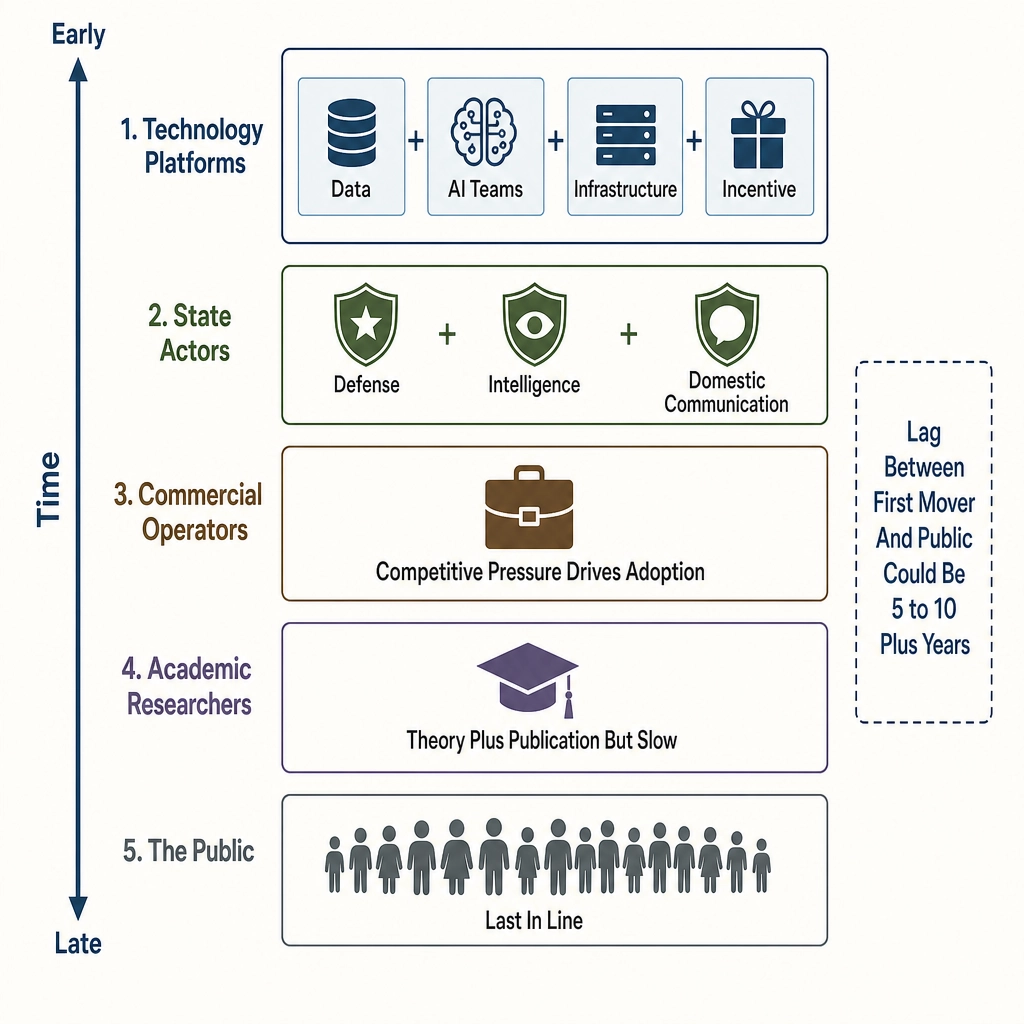
The timing of who develops this understanding matters more than whether it develops. Five categories of actors are positioned differently.
Technology platforms. Meta, Google/YouTube, TikTok/ByteDance, and other major platforms are best positioned. This ordering is inferred from published capabilities: Meta’s FAIR division published TRIBE v2, and platforms hold billions of engagement observations that are not available to other actors. They have the data (billions of content-engagement observations), the AI research teams (Meta FAIR produced TRIBE v2), the engineering infrastructure, and the business incentive. If any actor is already building something like this internally, it is most likely a platform. Whether they share the understanding with creators and consumers is a business decision, not a technical one. Chapter 1 section 1.2 described the current pattern: platforms analyze content at a level they do not share. This pattern could continue, deepen, or reverse. The author does not know which.
State actors. Governments with strong AI and neuroscience research programs - the United States, China, the European Union, the United Kingdom, Israel, and others - could develop neuroscience-informed content analysis as a national capability. The applications would include defense (evaluating adversary information operations), intelligence (understanding how content affects target populations), and domestic communication (designing government messaging). Whether this development occurs openly or covertly, and whether it includes safeguards, depends on institutional culture and governance structures that vary by country.
Academic researchers. The neuroscience and communication research communities already have the theoretical foundations. What they might lack is the engineering integration and the access to platform-scale behavioral data. Academic research tends to operate on smaller datasets, with longer timelines, and with publication norms that make findings public. If the understanding develops primarily through academic channels, it would diffuse more broadly but more slowly.
Commercial operators. Creative intelligence companies, advertising agencies, content studios, and independent creators could develop or adopt these tools as they become available. Their adoption would be driven by competitive pressure - if neuroscience-informed content analysis provides a measurable advantage, competitors who do not adopt it fall behind. This dynamic favors early adoption but not necessarily responsible adoption.
The public. The general public is last in line. This is the structural pattern for most technical knowledge: it originates in research, is adopted by commercial and state actors, and eventually diffuses to the public through education, media, and consumer products. The lag between first-mover adoption and public understanding could be five years, ten years, or longer. During that lag, the first movers operate with an informational advantage.
Counter-evidence to the adoption sequence. The sequence above - platforms first, public last - assumes the historical pattern of technology diffusion holds. But open-source AI tools have disrupted this pattern: Stable Diffusion, released in August 2022, gave the public access to image generation capabilities that were previously restricted to well-funded labs, within weeks of release. If brain encoding models follow a similar open-source trajectory (and TRIBE v2’s CC BY-NC release suggests they might), the lag between institutional and public access could be shorter than the historical pattern predicts. The constraint would shift from access to literacy - the tools are available, but understanding what they do requires domain knowledge that diffuses slowly.
5. What Changes If Understanding Becomes Widespread
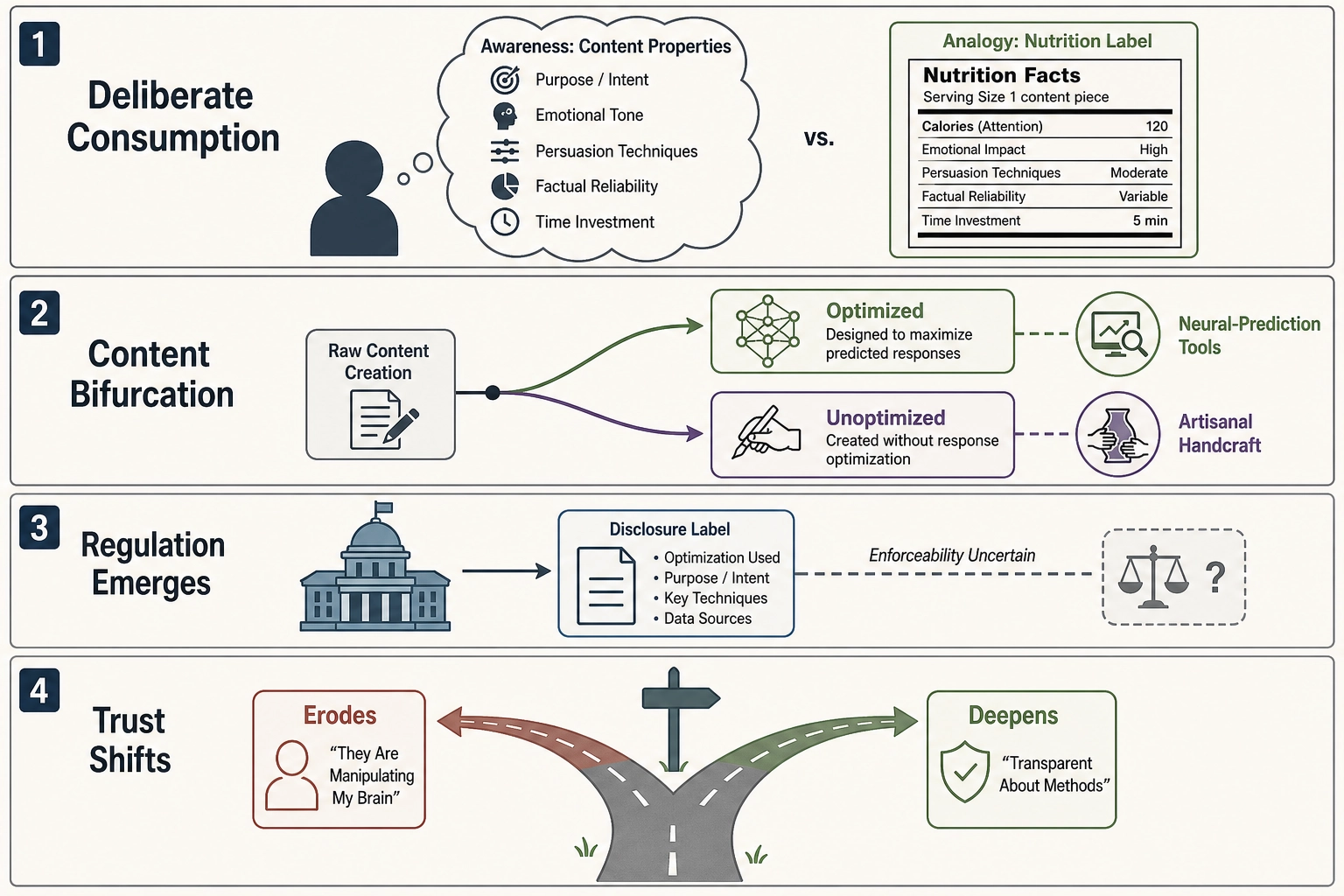
The most consequential question is not what happens when a few actors have this knowledge but what happens when most people do.
Content consumption could become more deliberate. If most viewers understand that content properties are designed to produce specific neural responses, they might consume content differently - not necessarily less, but with greater awareness. This is analogous to the effect of nutritional labeling on food consumption: a meta-analysis of food labeling effects found that labeling reduces calorie intake by 6.6% on average and also influences industry reformulation of products (the public health researcher Shuwen Shangguan and colleagues, 2019). Most people do not radically change their diet when they learn calorie counts, but the information changes the relationship from unconscious to conscious - and, critically, labeling changes producer behavior as well as consumer behavior. The dual mechanism (consumer awareness plus producer reformulation) parallels what might happen with neuroscience-informed content labeling: creators who know their optimization choices are visible may make different choices. Some people use the information actively; most absorb it passively; few ignore it entirely. The analogy has limits: nutritional labeling involves a single, well-understood metric (calories) applied to a physical product the consumer can inspect. Neural-engagement labeling would involve multi-dimensional predicted cortical activation patterns that are harder to summarize, harder to verify, and harder for a consumer to act on.
Content creation could bifurcate. If neuroscience-informed content analysis becomes standard practice, content might split into two categories: optimized content (designed using neural-prediction tools to maximize specific engagement patterns) and unoptimized content (created without these tools, valued precisely because it is not engineered). This bifurcation could mirror existing cultural distinctions - commercial vs. independent, mainstream vs. alternative, mass-market vs. artisanal - but with a new axis of differentiation: neurologically optimized vs. neurologically naive.
Regulation could emerge. If neuroscience-informed content optimization becomes widespread enough to attract regulatory attention, governments might require disclosure - labeling content that has been designed using neural-prediction tools, similar to how some jurisdictions require disclosure of AI-generated content. Whether such regulation would be effective depends on enforceability, which is uncertain. The content itself does not carry a visible marker of how it was designed. A video optimized for predicted cortical engagement looks the same as a video that was not. Detection would require either self-disclosure or forensic analysis.
Trust could erode or deepen. If audiences learn that content is designed to activate specific neural responses, trust in content creators could go in either direction. It could erode: “they are manipulating my brain” is a resonant narrative that could generate backlash against any content perceived as neurologically engineered. Or it could deepen: creators who are transparent about their methods - “we designed this content to engage your self-referential processing because we want you to reflect on this issue, not just watch it” - could build stronger trust through honesty about intent.
6. Falsifiability
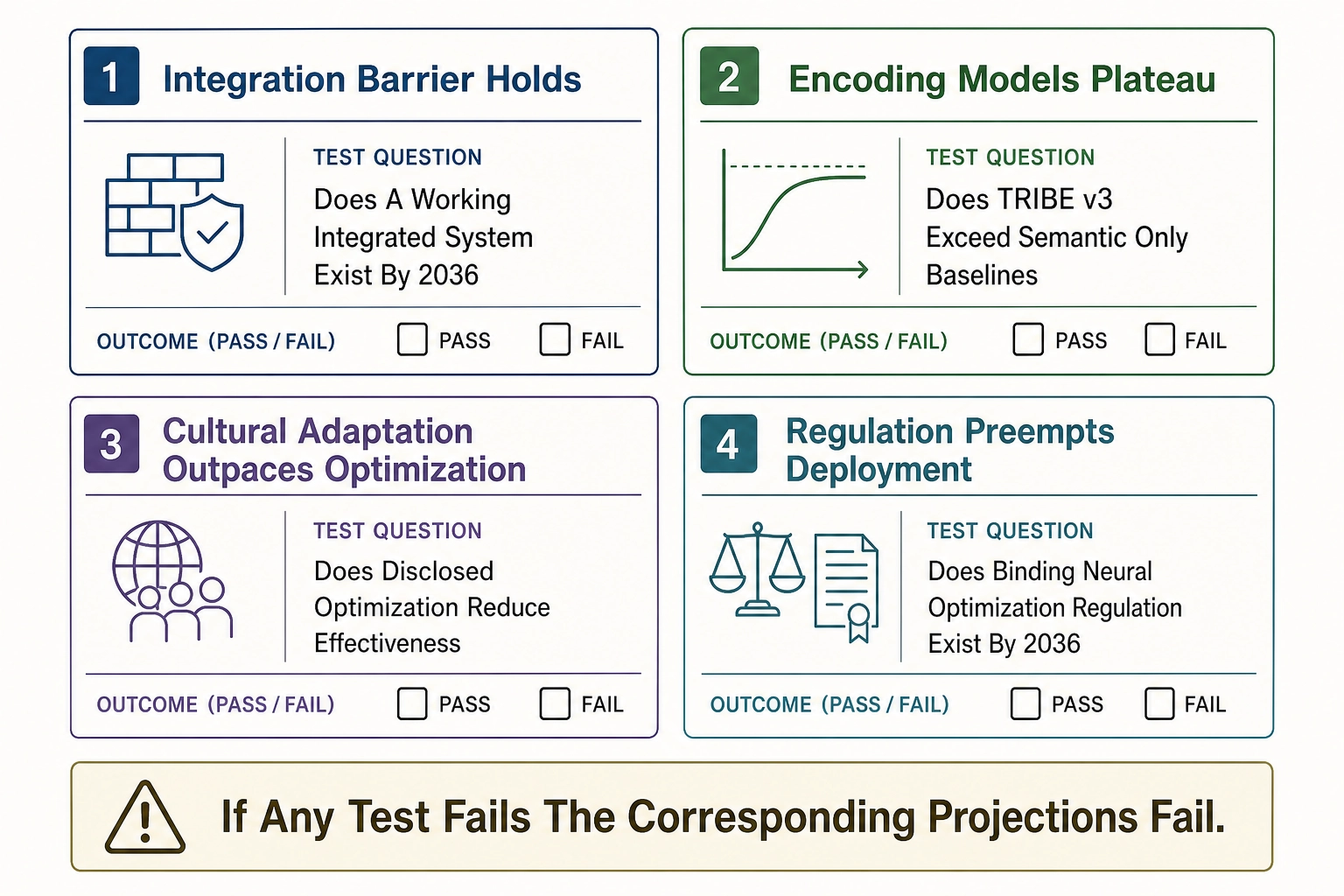
The projections in this chapter rest on structural claims that can be tested. If any of the following turns out to be true, the corresponding projections fail:
The integration barrier holds. If no actor - platform, state, researcher, or independent operator - succeeds in building a working content-performance prediction pipeline that integrates physics-level decomposition, brain encoding prediction, and behavioral measurement within the next ten years, then the “knowledge is coming regardless” framing (section 4) is wrong. The components may remain permanently fragmented across disciplines. The test is straightforward: does a working integrated system exist by 2036?
Encoding models plateau. If brain encoding model accuracy plateaus at a level too low to predict content performance - if the gap between predicted and measured cortical activation cannot be closed enough for Bet 2 to hold - then the cortical prediction layer adds no value, and the applications described in Chapter 12 that depend on it collapse. The test: does TRIBE v3 or its successor demonstrate content-performance prediction from predicted activation at a level that exceeds semantic-only baselines?
Cultural adaptation outpaces optimization. If audiences develop resistance to neuroscience-informed content optimization faster than the optimization improves - if the “cultural immune system” described in section 2.6 is stronger than the projections assume - then the harmful scenarios in the ten-year and twenty-year horizons are overstated. The test: does disclosed neural optimization reduce content effectiveness compared to undisclosed optimization, indicating audience adaptation?
Regulation preempts deployment. If regulatory action bans or severely restricts neuroscience-informed content optimization before widespread adoption occurs, then the “concentrated understanding” and “arms race” scenarios do not materialize in the form described. The test: does binding regulation specific to neural-prediction-based content optimization exist by 2036?
7. Honest Framing
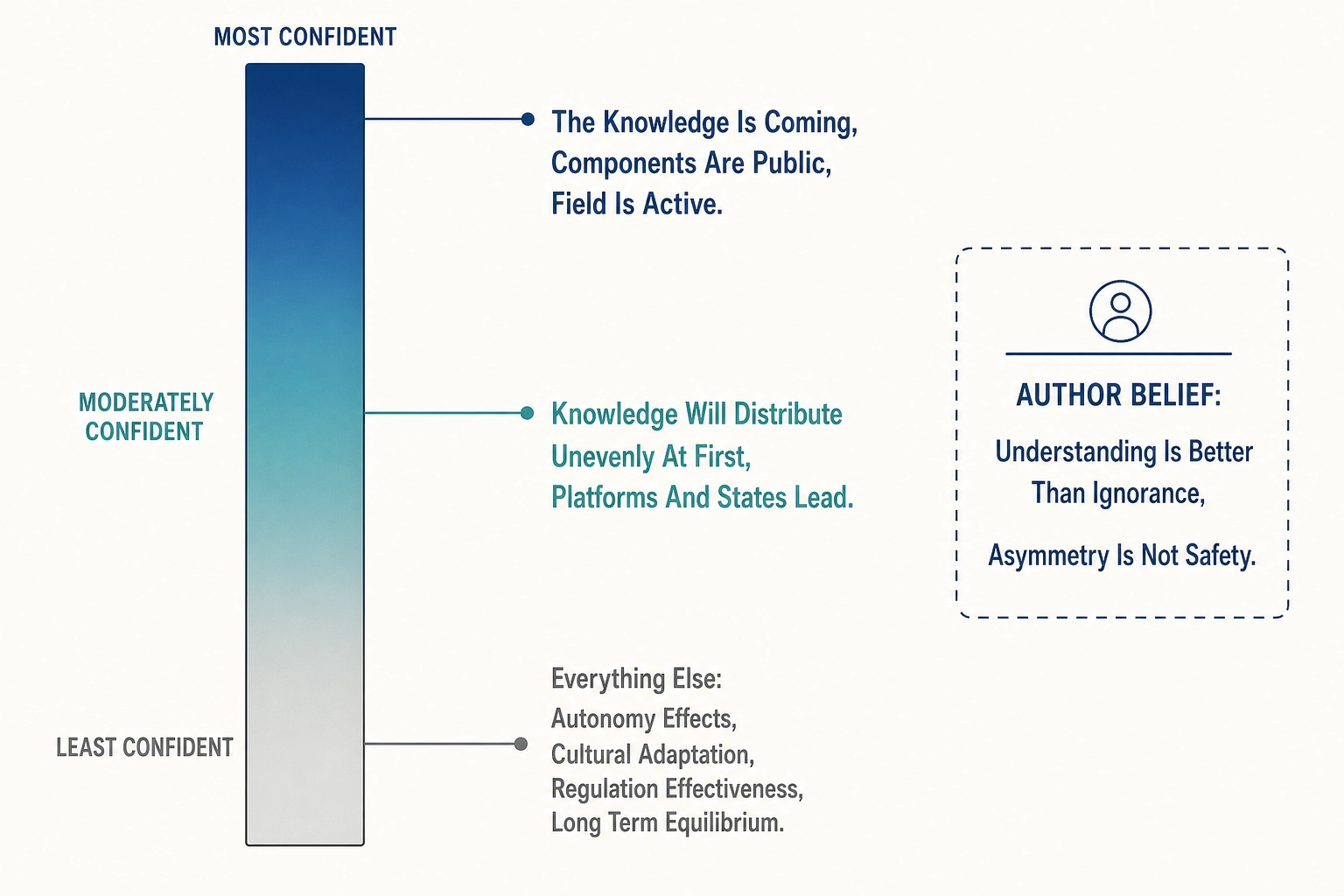
The author closes with an honest assessment of the chapter’s reliability.
What the author is most confident about. The knowledge is coming. The components are public, the research field is active, the engineering is tractable, and the commercial incentive is strong. Someone will integrate these layers into a working system. Whether it is Khozai or something else, the capability will exist.
What the author is moderately confident about. The knowledge will distribute unevenly at first. Technology platforms and state actors will likely develop the capability before the general public understands it. This creates a period of information asymmetry whose duration and consequences are uncertain.
What the author is least confident about. Everything else. Whether the knowledge improves or degrades individual autonomy. Whether cultural adaptation keeps pace with optimization. Whether regulation emerges and whether it works. Whether religious, educational, and artistic institutions adopt the tools wisely or harmfully. Whether the long-term equilibrium looks more like broadly distributed literacy or like a permanent informational asymmetry. The author does not know. The honest answer to “what happens when everyone knows?” is: it depends on choices that have not been made yet, by people who may not yet understand what they are choosing.
What the author believes, as a personal stance and not a framework output. Understanding is better than ignorance. Knowing how content affects the brain is better than not knowing, even when the knowledge can be misused. The alternative - remaining naive while others develop the understanding privately - is not safety. It is asymmetry. The question is not whether to pursue this knowledge but how to pursue it honestly, with epistemic discipline, and with both eyes open to the consequences.
This book is a v1 attempt at that pursuit. Everything in it - including this chapter - is subject to revision as evidence accumulates and understanding deepens. The framework is self-correcting by design, and this chapter is the most likely candidate for correction, because it is the chapter that strays farthest from what can be measured and tested.
The reader should hold all of it loosely. The author does.
8. Summary Table - Impact by Level and Horizon
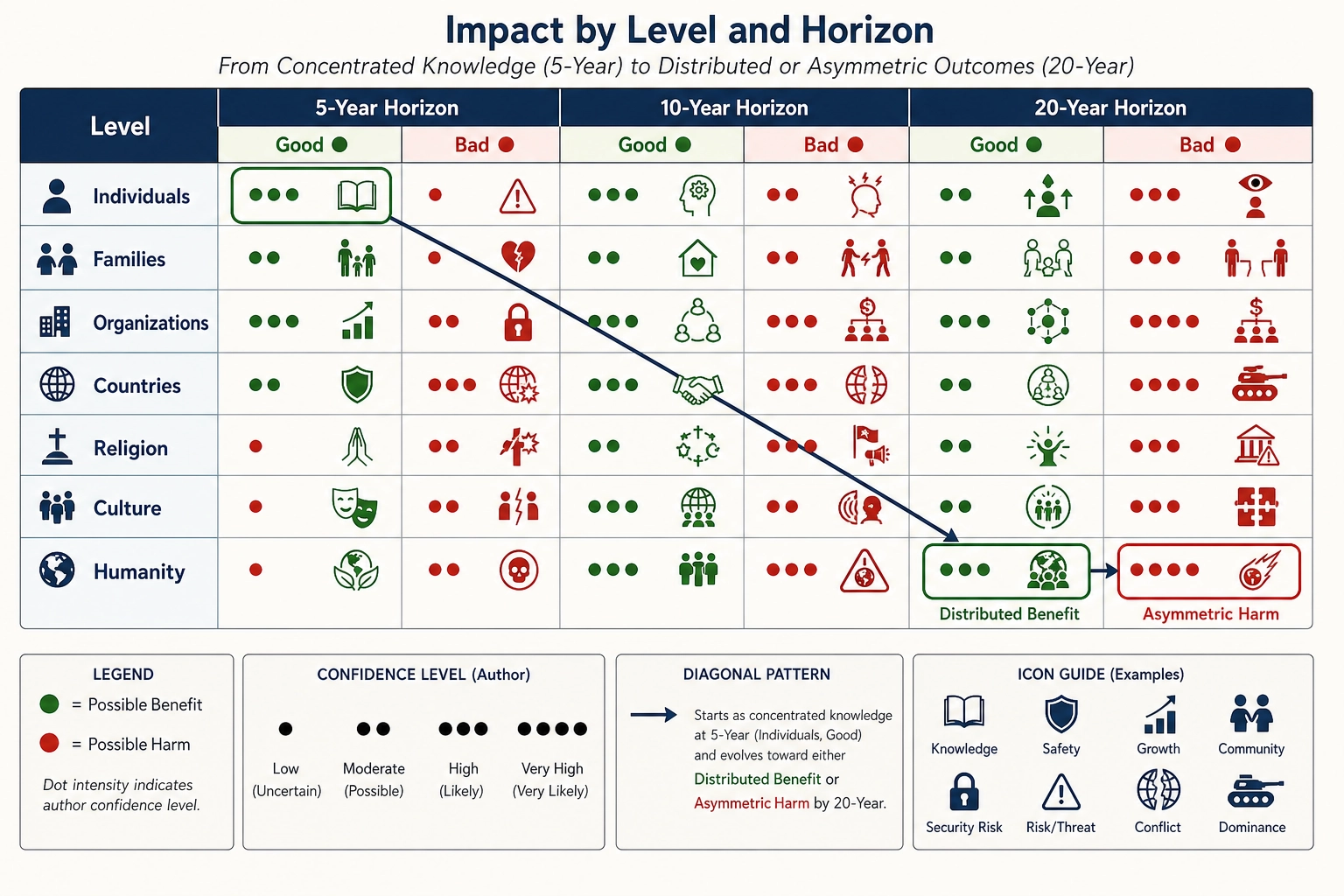
The following table consolidates the projections from sections 2 and 3 into a single reference. The table is included to reduce the cognitive load of holding multiple intersecting projections.
| Level | 5-Year Horizon (~2031) - Possible Good | 5-Year Horizon (~2031) - Possible Bad | 10-Year Horizon (~2036) - Possible Good | 10-Year Horizon (~2036) - Possible Bad | 20-Year Horizon (~2046) - Possible Good | 20-Year Horizon (~2046) - Possible Bad |
|---|---|---|---|---|---|---|
| Individuals | Early adopters could gain self-knowledge about their own media consumption patterns - understanding which neural responses content is likely activating | Partial knowledge without epistemic discipline could create confident ignorance - mistaking cortical-activation prediction for understanding of subjective experience | Wider availability of consumer-facing tools could empower more people to evaluate content critically | The gap between sophisticated and unsophisticated consumers could widen as tools become more capable but remain unevenly distributed | Neurological literacy could become as common as nutritional literacy - a baseline understanding most people carry | Permanent informational asymmetry could entrench if the understanding concentrates rather than diffuses |
| Families | Parents could evaluate children’s content based on predicted neural-engagement patterns rather than content ratings alone | Parental anxiety about neural effects of content could fuel over-control and a market for unvalidated “brain-safe” products | Shared family language about content design could emerge - discussing stimulus properties rather than just narrative content | Intergenerational conflict could intensify if children understand content optimization while parents do not, or vice versa | Family media literacy could include neuroscience-informed content evaluation as a standard skill | The commodification of children’s neural engagement could become a normalized market practice if regulation does not intervene |
| Organizations | Content-producing organizations could shift from intuition-driven to evidence-driven content development | Organizations could optimize for engagement metrics that serve the organization at the viewer’s expense, with greater precision | Nonprofits and educational institutions could design empirically grounded content that is both engaging and informative | An organizational arms race could force adoption regardless of ethical considerations - declining to optimize becomes a competitive disadvantage | Organizational content ethics could mature, with industry standards for responsible neural-engagement optimization | The most effective content could be produced by the organizations with the least ethical restraint, creating a race to the bottom |
| Countries | Countries with neuroscience research infrastructure could develop cognitive sovereignty - the ability to evaluate content consumed by their populations | State-level neuroscience-informed content analysis could be developed covertly without public oversight or safeguards | Regulatory frameworks for neuroscience-informed content could emerge in jurisdictions with strong consumer protection traditions | Geopolitical asymmetry in content-optimization capability could create new axes of informational advantage | International norms for neuroscience-informed content could develop, analogous to arms-control or environmental agreements | Content-optimization capability could become a component of state power, with arms-race dynamics between competing powers |
| Religion | Religious communicators could design content that is more effective at facilitating genuine reflection and empathy | Neuroscience-informed religious content could be optimized for emotional manipulation and compliance rather than genuine engagement | Religious institutions could develop ethical frameworks specific to neuroscience-informed communication | The line between facilitation and manipulation in religious communication could become harder to draw | Religious traditions could integrate neuroscience literacy into their communication ethics | Religious content optimization could become a normalized practice, reducing the distinction between spiritual communication and persuasion engineering |
| Culture | Cultural criticism could gain a new analytical dimension - discussing predicted neural consequences of aesthetic choices | Cultural production could converge toward neural-engagement optima, narrowing creative diversity | A cultural immune response could develop - audiences becoming literate about content design and valuing unoptimized content | The cultural immune response might lag behind the optimization capability, leaving audiences vulnerable during the gap | A rich dialogue between art, neuroscience, and audience literacy could produce new cultural forms | The concept of authentic aesthetic experience could erode if audiences perceive all content as neurologically engineered |
| Humanity | Widespread understanding of how content affects the brain could represent a genuine advance in collective self-knowledge | Unevenly distributed understanding could create a permanent epistemic asymmetry between optimizers and audiences | The knowledge could inform better decisions about media consumption, production, and governance at every level | The knowledge could be captured by actors whose objectives are not aligned with broad human welfare | Humanity could achieve a mature, informed relationship with its own media environment - knowing how content affects the brain and choosing consciously | The optimization could outpace the adaptation permanently, producing a world where content is more precisely engineered than audiences are equipped to evaluate |
Conclusion
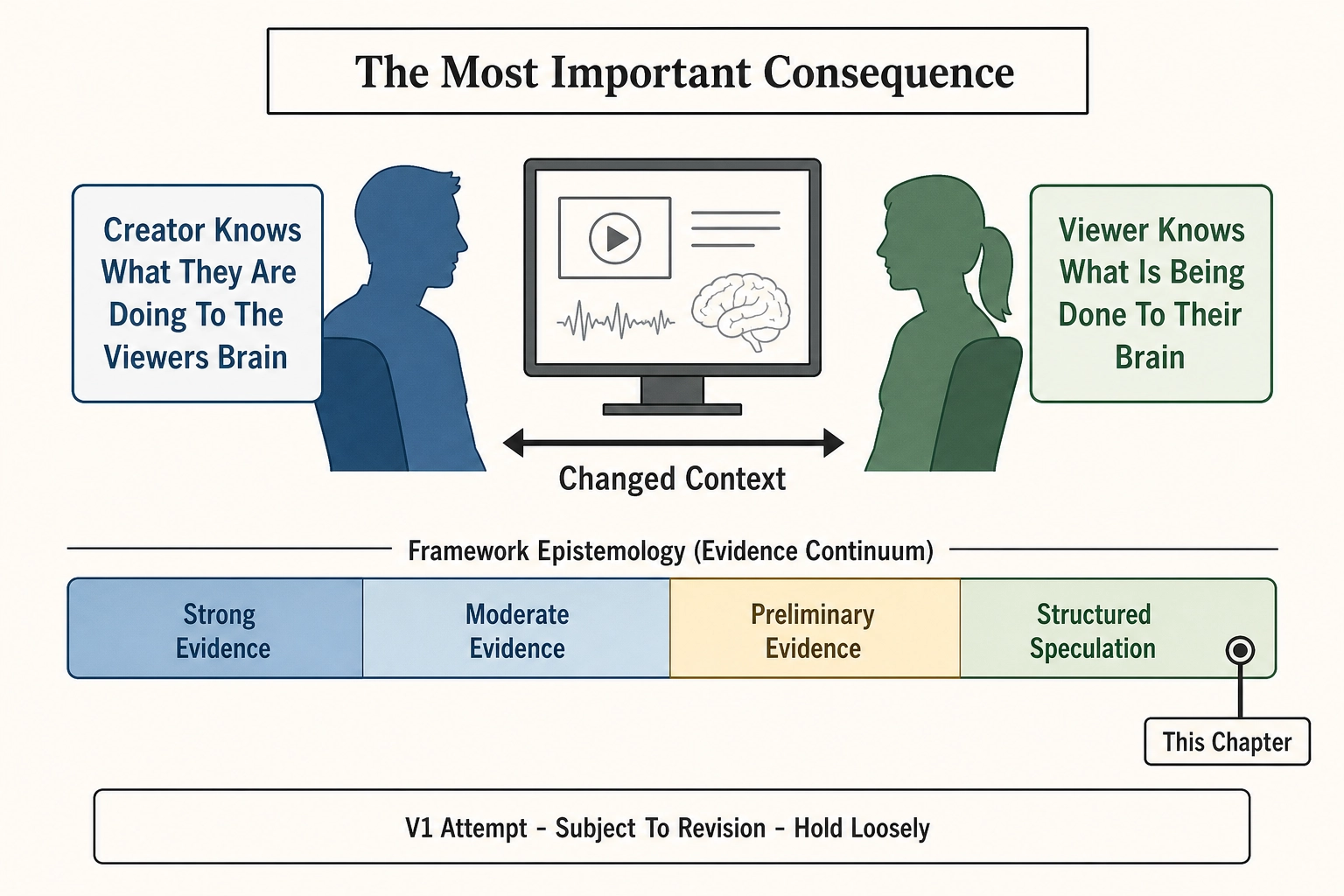
The most important consequence of the knowledge this book describes might not be any of the applications listed in Chapter 12 or any of the trajectories projected in this chapter. It might be the change in how humans understand their own relationship to the content they create and consume. If the understanding that physical stimulus properties map to neural activation, that neural activation maps to behavioral response, and that this chain is measurable, predictable, and manipulable becomes part of common knowledge - then every act of content creation and every act of content consumption happens in a different context. The creator knows, or could know, what they are doing to the viewer’s brain. The viewer knows, or could know, what is being done to their brain.
This book described a framework for understanding how physical content properties map to neural activation, how neural activation maps to behavioral response, and how that chain can be measured, predicted, and tested. The framework is a v1 - incomplete, constrained by its bets and limitations, and subject to revision as evidence accumulates. What it offers is not certainty but a disciplined method: premises stated explicitly, predictions tested empirically, failures treated as information rather than embarrassments. The framework’s epistemology is graded throughout, never binary. Claims carry evidence ratings (Strong, Moderate, Preliminary). Vectors carry a confidence gradient (V0 highest through Ve lowest). Dimensions carry confidence tiers (higher for cortical, lower for subcortical). Dissociations carry type labels (double or single). Correlations carry Tool 11 classifications. At no point does the framework assert certainty about any empirical claim - only degrees of confidence, with the basis for each degree stated explicitly and subject to revision as evidence accumulates.
Whether Khozai succeeds or fails, the knowledge it attempts to formalize - that content affects the brain through measurable physical mechanisms - is part of the scientific record and will be built upon by others. The author’s hope is that this book contributes to a future where that understanding is widely shared rather than privately held, honestly pursued rather than quietly exploited, and held with the epistemic humility that any v1 attempt at a hard problem demands.
Bibliography
[1] Falk, E. B., Berkman, E. T., & Lieberman, M. D. From Neural Responses to Population Behavior: Neural Focus Group Predicts Population-Level Media Effects. Psychological Science, 23(5), 439-445, 2012. [EMPIRICAL] Used in: section 2 (brain-based prediction of population-level content outcomes).
[2] Meta FAIR. TRIBE v2: Brain Encoding Model. Released March 26, 2026. CC BY-NC 4.0. [MODEL RELEASE] Used in: section 4 (encoding-model licensing trajectory and three-option licensing analysis).
[3] Scholz, C., Chan, H.-Y., Falk, E. B., et al. A Mega-Analysis of Neural Predictors of Message Effectiveness. PNAS Nexus, 4(11), 2025. [EMPIRICAL] Used in: section 2 (mega-analysis confirming cross-domain neural prediction).
[4] Tong, L. C., Acikalin, M. Y., Genevsky, A., Shiv, B., & Knutson, B. Brain Activity Forecasts Video Engagement in an Internet Attention Market. PNAS, 117(12), 6936-6941, 2020. [EMPIRICAL] Used in: section 2 (brain activity predicting real-world video engagement).
[5] Venkatraman, V., Dimoka, A., Pavlou, P. A., et al. Predicting Advertising Success Beyond Traditional Measures: New Insights from Neurophysiological Methods and Market Response Modeling. Journal of Marketing Research, 52(4), 436-452, 2015. [EMPIRICAL] Used in: section 2 (neurophysiological prediction of advertising effectiveness).
[6] Algonauts 2025 Challenge. Algonauts Project, 2025. [COMPETITION] Used in: section 4 (260+ participating teams as evidence of encoding-model ecosystem growth).
[7] Shangguan, S. et al. A Meta-Analysis of Food Labeling Effects on Consumer Diet Behaviors and Industry Practices. American Journal of Preventive Medicine, 56(2), 300-314, 2019. [META-ANALYSIS] Used in: section 5 (nutritional labeling analogy: labeling reduces calorie intake by 6.6% and influences industry reformulation).