Khozai
In ancient Hebrew, the word חוזה - transliterated as Chozeh, Hozai, or Khozai - means seer. Not a fortune-teller. Not a mystic. A seer: one who perceives what is happening beneath the surface of things, who looks where others look and sees what others miss.
In the Hebrew Bible, the Khozai were distinct from ordinary prophets. A prophet delivered a message. A seer perceived a reality - saw the forces, the patterns, the mechanisms that others experienced only as effects. The prophet told you what to do. The seer showed you what was actually going on.
That distinction is the entire premise of this book.
Every day, billions of people watch content and feel something - interest, boredom, desire, trust, urgency. They experience the effects. But the mechanisms that produce those effects - the way a stimulus enters the eye, activates specific neural populations, triggers emotional and motivational circuits, and emerges as a behavioral decision - remain invisible. The viewer feels compelled to keep watching. They do not see why.
The platforms see why. They have built billion-dollar systems to see why. This book is about building that same sight for yourself.
Khozai is not a product. It is not software. It is a framework for becoming a seer of attention - for looking at a piece of content and perceiving, with precision, what it will do to a human brain and why.

The most valuable knowledge in the world is knowledge about attention
Right now, as you read this sentence, the five largest companies on Earth are competing for the same resource: human attention. Not oil, not data, not compute. Attention. The ability to make a person stop scrolling, start watching, keep watching, and act on what they saw.
Whoever controls attention controls everything that follows.
A government that understands how to hold attention can shape public opinion on a war, an election, a policy - not by censoring opposition, but by making its own message neurally stickier, more emotionally resonant, harder to look away from. A corporation that understands attention can drive sales not by making a better product, but by engineering a stimulus that activates the viewer’s reward circuitry at exactly the right moment to trigger a purchase decision. A creator who understands attention can turn views into revenue - not through luck, but through systematic knowledge of what makes a human brain keep watching for one more second, then one more after that.
This is not hypothetical. It is happening at industrial scale.
Content drives the global economy at a magnitude most people never pause to calculate. YouTube pays creators over $70 billion. TikTok generates over $100 billion in annual revenue. Netflix, Disney, Amazon, and Apple collectively spend over $80 billion per year producing content. Digital advertising exceeded $600 billion globally in 2024. Behind every dollar is a bet: that this piece of content will capture and hold the attention of enough brains, for long enough, to produce value.
But the money is only the surface. Underneath the economics is something more fundamental: the ability to change what people believe, what they want, what they fear, and what they do. A thirty-second video that holds attention through the right emotional arc can shift a viewer’s stance on a political issue more effectively than a thousand-page policy document. A product review that triggers the right neural signatures of trust and desire can drive more sales than a billboard seen by a million people. A public health message that engages the right cortical networks can change behavior in ways that pamphlets and posters never could. Attention is not just a metric. It is the gateway to influence, persuasion, and behavioral change at the scale of entire populations.
And every one of those bets is made mostly blind.
Creators publish content and wait. They look at view counts, watch time, engagement rates. They test thumbnails, try different hooks, adjust pacing by instinct. When something works, they do not know why. When something fails, they do not know why. The feedback they get - likes, shares, completion rates - describes what viewers did, never what viewers experienced. The scoreboard is visible. The game is not.
Meanwhile, on the other side of the screen, the platforms know more than they share. Meta’s recommendation systems decompose your content into hundreds of features, match it against individual viewer profiles, and predict - before anyone watches - whether this video will hold this specific person’s attention. TikTok’s algorithm evaluates your content within milliseconds of upload. YouTube’s Gemini models process your video with multi-modal understanding that exceeds most human analysis. These systems work because they operate, implicitly, on the same neuroscience this book makes explicit: content engagement is not random. It is driven by measurable properties of a stimulus interacting with known systems in the human brain.
The science behind this is not secret. The neuroscience of attention, reward, emotion, and decision-making has been published for decades. Brain encoding models are open-source. The research papers are freely available. But the knowledge is scattered across hundreds of journals, buried in technical language, disconnected from practical application. This book puts the picture together.

This book is about underlining the importance and the seriousness of this critical knowledge, putting the picture together, and presenting it in a way that anyone can understand.
What you are about to learn
Khozai is a formal framework that connects the physical properties of video content to what happens inside the viewer’s brain to what the viewer does afterward. Not metaphorically. Mechanistically. With numbers.
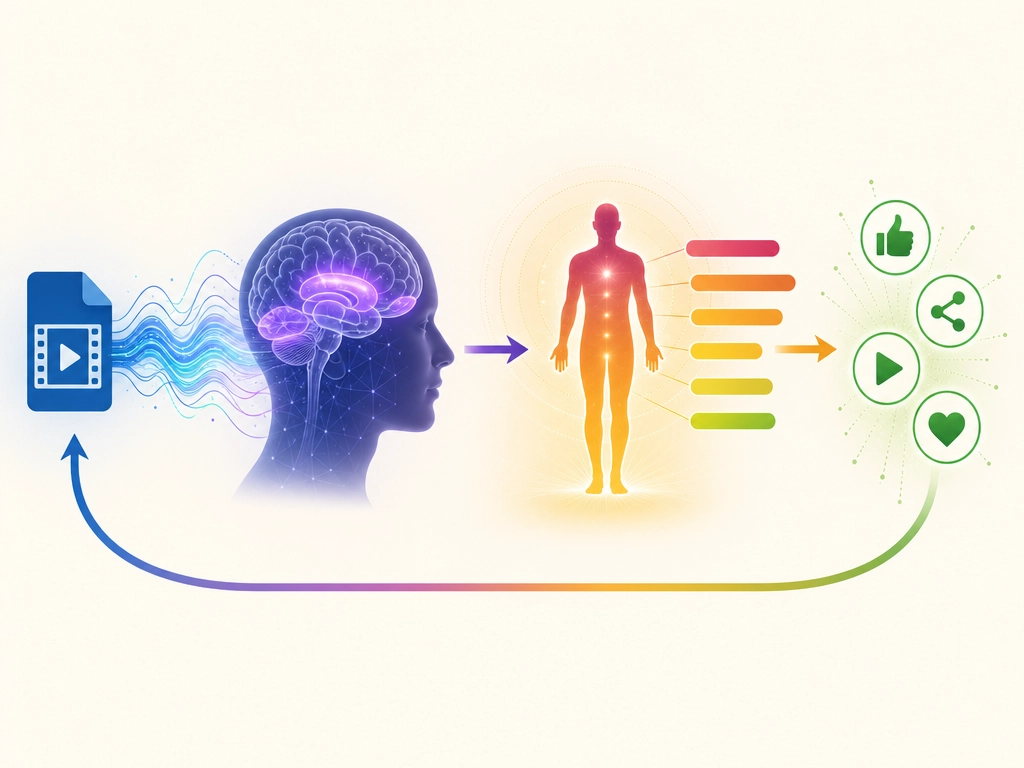
The framework decomposes content into its raw physics - the actual signal that hits the retina and cochlea. It predicts what the brain will do in response, region by region, second by second, from the video file alone. It maps that neural activation to a complete hierarchy of human experience. It generates controlled variants that change one property at a time. It measures what viewers actually do across platforms. And it accumulates causal knowledge - a growing graph of what content properties drive what behavioral outcomes, sharpened by every experiment.
The result is a closed loop: measure content, predict brain response, generate variants, publish, observe behavior, correlate, interpret, and feed the findings back into the next cycle. Each cycle makes the system more accurate. Each experiment generates original knowledge about how content engages humans.
Why this knowledge is worth a fortune

The framework rests on three central bets. That the raw physics of content - not just what it means, but what signal actually hits the brain - carries predictive power that semantic analysis misses. That predicted brain activation, computed from a video file alone, can forecast what real viewers will do. And that controlled experimentation - changing one property at a time, measuring the difference - can turn content optimization from guesswork into a repeatable discipline.
If all three bets pay off, the framework becomes the most powerful content optimization system ever built outside a major platform. Not because it replaces human creativity - it does not - but because it gives creators the same type of knowledge that platforms use internally but never share externally.
And the knowledge compounds. Every experiment adds to the causal graph. Every mutation refines the calibration. Every correlation sharpens the prediction. A creator running 200 experiments over six months builds a persona-specific model of what their audience responds to, grounded not in vanity metrics but in predicted neural activation patterns. That model is an asset. It is proprietary. It is valuable. And it gets more valuable with every experiment.
The power, the danger, and why both matter

This book does not pretend that this knowledge is safe.
The same methods that could help a health campaign save lives could engineer addiction. The same tools that help a creator find their best edit could optimize propaganda below the threshold of conscious detection. Every constructive application has a destructive mirror. The mechanisms are identical. Only intent differs.
This book treats both sides with equal specificity - because a framework that advertises its benefits while hand-waving its harms is doing marketing, not science.
It publishes anyway, because the knowledge is coming regardless. Brain encoding models are open-source. The neuroscience is published. The engineering tools are freely available. What this book contributes is integration, not invention. And concentrated knowledge is more dangerous than distributed knowledge. A world where only platforms and state actors understand how content engages the brain is a world with a permanent information asymmetry. Understanding how the game works is the first defense against being played.
Who this book is for
This book is for anyone who wants to understand, at a deep technical level, how content engages the human brain. It was written for the author first - a personal project to build independent understanding of a domain dominated by platforms that do not share what they know.
The intended reader is technically literate: an engineer, researcher, creator, strategist, or scientist who can absorb formal concepts when bridges are provided. No prior neuroscience is required. Every technical term is explained on first use. Every claim is sourced. Every limitation is stated.
You should read this book if you want to:
- Understand what happens between a viewer pressing play and deciding to share
- Build a measurement system for content that goes beyond vanity metrics
- Design experiments that generate causal knowledge about what makes content work
- Compete with platforms using the same class of knowledge they use internally
- Understand the neuroscience of attention, emotion, motivation, and engagement as it applies to media
- Think seriously about the dual-use implications of content optimization at the neural level
You should not read this book if you want quick tips, growth hacks, or a formula for viral content. Content engagement is driven by complex biological systems interacting with individual histories, states, and contexts. Anyone claiming a formula is selling something. This book sells nothing. It documents understanding.
How this book is structured

The thirteen chapters build a complete system from the ground up. Each chapter introduces concepts and vocabulary that later chapters use. Reading in order is recommended.
Part I: Foundation - Why the framework exists, the brain science it rests on, and the complete map of human experience it targets.
Part II: Measurement - What Khozai measures about content and what it measures about viewer behavior.
Part III: Experimentation - How to generate controlled content variants, map properties to outcomes, and run the full pipeline end to end.
Part IV: Governance - The calibration system that keeps the framework honest and self-correcting.
Part V: Reckoning - What the framework cannot do, what it could be used for, and what happens when this knowledge becomes widespread.
A note on honesty
This book contains two types of content.
The first is verified fact. Every factual claim has been checked against primary sources. Lead authors, institutional affiliations, journal names, publication years, and statistical figures are verified individually.
The second is testable hypothesis. The three central bets are not established truths. They are empirical questions with defined success and failure criteria. Every time the book makes a bet, it says so. Every time it speculates, it labels the speculation. Every time it presents a correlation, it states the confidence level.
The boundary between these two types is maintained throughout. Bets are framed as bets, not as facts. Risks are separated from bets. Evidence is framed as a green flag, not as a guarantee. No claim is made without epistemic qualification.
This is a v1
The framework presented here is the author’s current best formulation. It is not a settled doctrine.
The framework’s own principles - hypotheses not truths, self-correcting, every claim falsifiable - require that it change as evidence accumulates. What you are holding is a complete architecture for understanding content engagement, designed to get less wrong over time, transparently, with every correction recorded.
The experiments come next. Turn the page.